

Plant Health 101: Why Are My Leaves Turning Yellow or Brown?


Have you ever brought home a stunning plant from a shop, intending to decorate your living room or desk for that perfect minimalist look?
But after just a few weeks, that vibrant green starts to fade... Your plant begins to show strange symptoms that make your heart sink.
"Why are the leaves turning yellow? Why are the edges burnt?" or "Did I water it wrong?"
Please don't be discouraged or label yourself a "Plant Killer" just yet. Actually, your plant is trying to communicate with you. Since it cannot speak, it signals its distress through its "leaves" instead.
Today, Thai Tissue Culture volunteers to be your "Plant Interpreter." We will help you translate this "leaf language" and decode these SOS signals, along with first aid tips to restore your plant to its former glory!
Common Symptom Checklist: What Is Your Plant Trying to Tell You?
Most common issues with ornamental plants are not caused by serious diseases, but rather by an
"imbalanced environment" (Light, Water, and Air).
Let's take a closer look to see which of these three factors might be the root of the problem for your plant:

🟡 Symptom 1: Yellow Leaves
Yellow is the number one warning sign, but the type of yellowing tells a different story.
A. Yellowing leaves + Leaf drop + Soft stems
Translation: "I can't breathe! Too much water!"
Cause: Overwatering. The soil is constantly soggy, causing the roots to suffocate (lack of oxygen) and eventually rot.
Solution: Stop watering immediately! Check the bottom of the pot to see if the drainage holes are clogged or if water is pooling in the saucer. If the soil smells rotten, repot the plant with fresh, well-draining soil right away.
B. Pale yellow all over OR Yellow leaves with green veins
Translation: "I'm hungry..."
Cause: Nutrient Deficiency or sometimes caused by degraded soil quality.
Solution: Your plant is hungry. Feed it with a balanced fertilizer or slow-release fertilizer (like Osmocote) in the appropriate amount. The symptoms should gradually improve.

🟤 Symptom 2: Brown Edges / Burnt Tips
This is a very common issue for beautiful foliage plants grown indoors or in air-conditioned rooms.
A. Crispy Brown Edges
Translation: "My skin is too dry! I can't take it!"
Cause: Low Humidity or dehydration. This is frequently found in air-conditioned rooms where the air is naturally dry.
Solution: Plants need skincare just like humans! Try misting water around the plant to increase humidity, or simply place a cup of water next to the pot to help.
B. Brown Scorch Marks in the Center of the Leaf
Translation: "It's too hot! I'm burning!"
Cause: Sunburn.
Solution: The sun in Thailand is hotter than you think. If you place a shade-loving plant near a west-facing window with direct sunlight, its leaves will likely burn. Move it to a shadier spot or install sheer curtains to help filter the light.
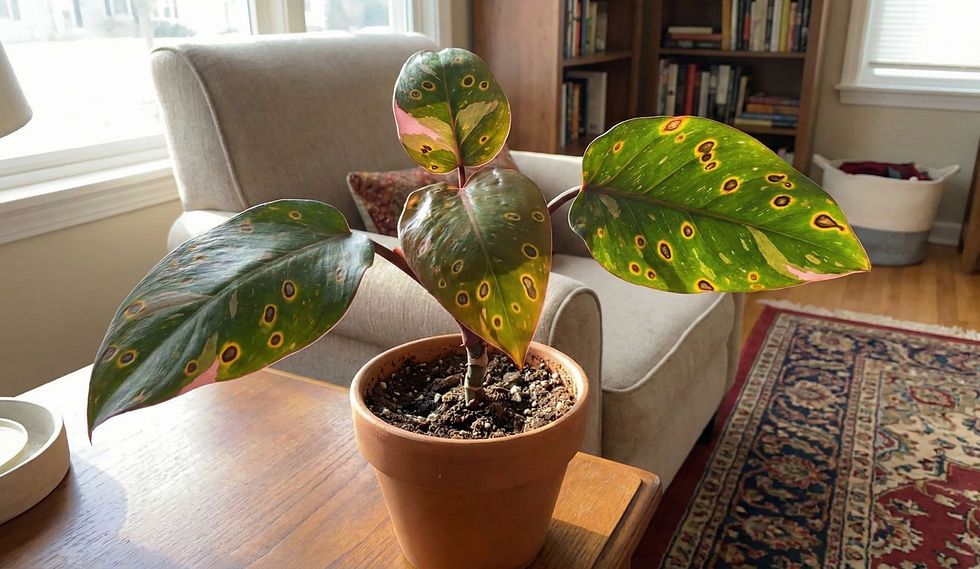
⚫ Symptom 3: Black Spots / Brown Spots
Brown or Black Spots with a Yellow Halo
Translation: "I have an infection!"
Cause: Fungal or Bacterial Infection. This is usually caused by excessive dampness or water lingering on the leaves without drying properly.
Solution: You have to be tough! Cut off the infected leaves immediately to prevent the disease from spreading to other leaves. Avoid spraying water directly on the foliage and move the plant to a spot with better air circulation.
How to Create an Indoor Garden Corner Where Plants Thrive
Rather than just fixing problems at the symptom level, the best prevention is simply:
"Right Place, Right Care"
1. Light is the Main Food Source
Don't be fooled by the term "Indoor Plants"—it does not mean "No Light." Every plant needs brightness (specifically Indirect Light) for photosynthesis.
Tip: If your corner is too dark, try rotating your plants to a balcony once a week to soak up some natural light. Alternatively, using Grow Lights is a great solution that helps them thrive while adding a chic café vibe to your home.
2. The Golden Rule of Watering
Stop watering on a strict schedule (like every morning) because the weather changes daily. Instead, rely on the "Finger Test": Stick your finger into the soil about one knuckle deep (approx. 1 inch).
If the soil is dry → It’s time to water.
If the soil is still moist → Wait a while longer.
Quick Recap
Yellow & Soggy Leaves = Root Rot → Stop watering immediately!
Pale Yellow Leaves = Nutrient Deficiency → Time to fertilize.
Burnt Edges = Dry Air or Sunburn → Increase humidity or move to the shade.
Spots with Rings = Fungal Infection → Cut the leaf & isolate the plant
Thai Tissue: Your Trusted Partner for Plant Lovers
Caring for plants is much like nurturing a relationship—it requires attention and observation. However, when you start with the right understanding, having a green space in your home becomes the simplest form of happiness.
Whenever you are looking for a new plant to fill an empty corner, or if you need expert advice on different varieties, Thai Tissue is always here for you. We are an international-standard tissue culture laboratory that shares your passion for plants. You can be confident that every plant from us has been carefully nurtured and is ready to thrive beautifully in your home.
🌱Other Contacts🌱
☎️ : 06-4475-7495 , 08-8629-4513
Line OA : https://lin.ee/UQFnpoN
Website : https://www.thaitissues.com/
✨Channel For Ordering✨
Facebook Fanpage : ไทยทิชชู – ต้นไม้เพาะเนื้อเยื่อ ( Inbox 📩)
TikTok Shop : https://www.tiktok.com/@thaitissueshop
Shopee : https://shopee.co.th/thaitissue


Comments