

What Documents Are Required to Export Tissue Culture Plants? A Practical Guide for Thai Exporters

Exporting tissue culture plants is not simply a matter of placing sterile plantlets in bottles, packing them into boxes, and shipping them overseas. Although tissue culture plants, or in vitro plantlets, are grown on sterile agar medium, contain no soil, do not use natural growing media, and are kept in sealed containers, many countries still classify them as live plants, plants for planting, or plant propagation material under plant quarantine regulations.
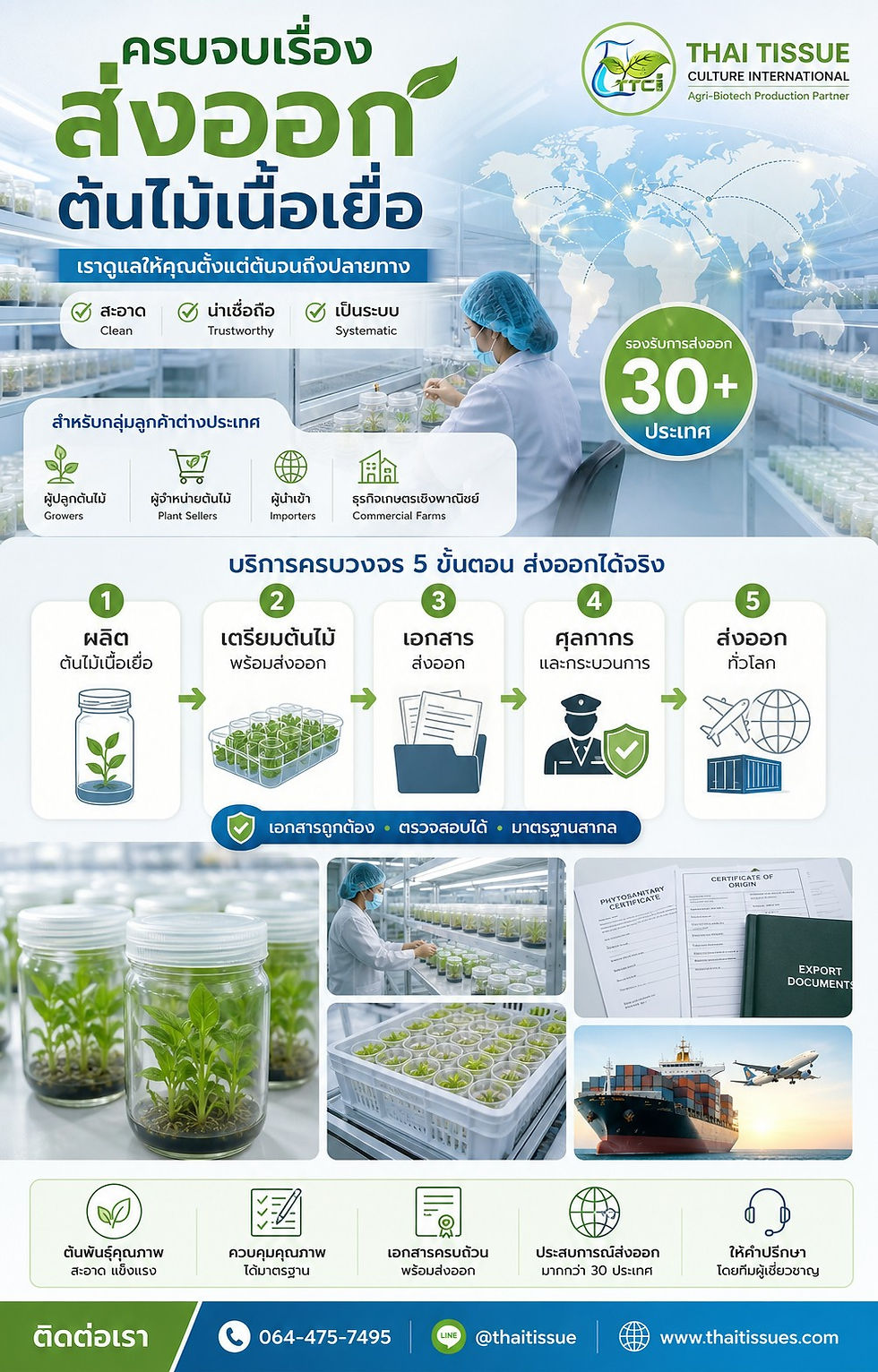
For this reason, plant tissue culture exports must be supported by proper documentation. The most important document is usually the Phytosanitary Certificate, and in many destination countries, the importer must also obtain an Import Permit before the shipment is allowed to travel.
The first group of documents exporters need to understand is the commercial documentation between buyer and seller. These typically include the Proforma Invoice, Commercial Invoice, Packing List, Purchase Order, and Air Waybill. These documents are not just paperwork for sales transactions. They are the core information used by customs authorities, logistics providers, and plant quarantine officers to verify what is being exported, how many units are included, what the shipment value is, and whether the information matches other permits or certificates.
For example, if the invoice states 1,000 plantlets but the packing list states 900 plantlets, or if the plant name differs from one document to another, the shipment may be questioned either at the origin or destination country. In export work, consistency across documents is not a small detail. It is one of the foundations of a smooth shipment.

The most important document for exporting tissue culture plants is the Phytosanitary Certificate, a plant health certificate issued by the official government authority of the exporting country. In Thailand, this is issued by the Department of Agriculture. This certificate confirms that the shipment has been inspected according to the requirements of the destination country.
Today, many countries are moving toward e-Phyto, or electronic phytosanitary certification. An e-Phyto carries information equivalent to a paper certificate and allows plant health data to be exchanged between countries in a more systematic way. However, the key point is not simply having the certificate. The information on the certificate must match all other shipment documents.

Before applying for a Phytosanitary Certificate, exporters should always check the import requirements of the destination country. Many countries require the importer to obtain an Import Permit in advance. This permit may specify important details such as the scientific name of the plant, permitted quantity, product form, packaging conditions, and any Additional Declaration that must appear on the Phytosanitary Certificate.
For example, if a customer wants to import tissue culture Nam Wa banana plants, the exporter should avoid using only a vague description such as “banana tissue culture.” A clearer and more appropriate description would be:
“In vitro plantlets of Musa spp., Nam Wa Banana variety, produced by plant tissue culture, packed in sterile glass flasks, free from soil and extraneous organic matter.”
This kind of description helps officials understand exactly what the product is: sterile in vitro plantlets in closed containers, not soil-grown plants or potted plants.
Another point exporters must be careful about is whether the plant species is subject to CITES or conservation-related regulations. Certain plants, such as some orchids, cacti, cycads, and rare plant species, may fall under CITES controls. If the product is listed under CITES, a CITES Export Permit may be required from the exporting country, and in some destination countries, a CITES Import Permit may also be required.
Exporters should also check whether the plant is controlled, restricted, reserved, or subject to any specific Thai regulations. Sending plants without checking these requirements can create problems from the certificate application stage all the way to customs clearance.
For tissue culture plants, one of the most important operational points is making sure the information is consistent across every document. The scientific name, cultivar or variety name, number of plantlets, number of bottles, number of boxes, weight, packaging method, and consignee details should match across the Commercial Invoice, Packing List, Import Permit, Phytosanitary Certificate, Air Waybill, and box labels.
A suitable product description for export documents may be:
“In vitro plantlets of [Scientific Name], cultivar/variety [Variety Name], packed in upright sterile glass flasks, sealed with screw caps and plastic wrap, cultured on sterile agar medium, free from soil and extraneous organic matter, intended for planting/propagation.”
This description gives plant quarantine officers a clear picture of the product. It shows that the shipment consists of sterile tissue culture plants in sealed containers, not regular plants with soil or growing media attached.
Although tissue culture plants have advantages over potted plants because they contain no soil and reduce risks related to insects, soil, and natural growing media, this does not mean they can be exported without documentation. Many countries still evaluate plant imports based on species, origin, purpose of import, and pest risk.
In some cases, sterile medium used for tissue culture may be exempt from certain growing media restrictions. However, the shipment may still require a Phytosanitary Certificate or other conditions depending on the destination country. In other words, “sterile” in a laboratory context does not mean “document-free” in a legal export context.
A good export process should begin before the order is accepted. The seller should first confirm whether the plant species can be imported into the destination country, whether an Import Permit is required, whether an Additional Declaration is needed, and whether the plant is subject to CITES or Thai export restrictions.
After that, the importer should apply for the Import Permit using information provided by the exporter, such as the company name, address, scientific name, variety name, quantity, product form, and shipping method. Once the Import Permit is received, the exporter can prepare the invoice, packing list, and e-Phyto application using consistent information across every document. This approach reduces the risk of repeated corrections and helps the inspection process proceed more smoothly.
Many shipment problems are not caused by one major mistake, but by small inconsistencies. Common issues include using only a trade name without the scientific name, having different quantities across documents, shipping before the importer has obtained an Import Permit, listing a consignee on the Air Waybill that does not match the importer on the permit, or failing to include a required Additional Declaration on the Phytosanitary Certificate.
Packaging issues can also create problems. Broken bottles, leaking agar, or visible contamination may raise concerns with plant quarantine officers at the destination, even if the paperwork is complete. For tissue culture exports, documentation and product condition must work together.
The same basic principle applies to importing tissue culture plants into Thailand. Importers should check the requirements with the Department of Agriculture before bringing plants into the country. In general, documents may include P.Q.5, Import Permit where applicable, Phytosanitary Certificate from the country of origin, Commercial Invoice, Packing List, Air Waybill, and CITES Permit if the plant is listed under conservation regulations.

Imported plant shipments must pass inspection at the plant quarantine checkpoint. If the documents are incorrect, certification is missing, or pest risk is detected, the shipment may be detained, returned, or destroyed in accordance with the law.
In summary, successful tissue culture plant export requires both commercial readiness and plant quarantine compliance. The core documents required for most shipments include Commercial Invoice, Packing List, Air
Waybill, and Phytosanitary Certificate or e-Phyto. Other documents, such as Import Permit, CITES Permit, Certificate of Origin, Non-GMO Statement, Sterility Statement, and Additional Declaration, depend on the plant species and the destination country.
For a business like Thai Tissue Culture, building a clear documentation system from the beginning does more than help shipments pass inspection smoothly. It also reflects the professionalism of Thai exporters in the eyes of international customers. In the plant propagation business, having plants ready for sale is important. But having the right documents is what allows those plants to actually reach their destination.
✨ channel for ordering ✨
Facebook Fanpage : ไทยทิชชู – ต้นไม้เพาะเนื้อเยื่อ ( Inbox 📩)
TikTok Shop : https://www.tiktok.com/@thaitissueshop
Shopee : https://shopee.co.th/thaitissue
🌱Other Contacts🌱
☎️ : 06-4475-7495 , 08-8629-4513
Line OA : https://lin.ee/UQFnpoN
Website : https://www.thaitissues.com/


Comments