

Why Tissue Culture Cannot Be Treated Like a 100% Factory Process
- TTCI Blog
- 2 days ago
- 3 min read

Tissue culture is controlled, but it is not a 100% factory-output promise
Plant tissue culture is a controlled propagation technology that helps multiply selected plant material under managed conditions. It should not, however, be presented as a machine-like process where every initiated unit becomes a finished plant. The USDA/ARS Micropropagation system document treats micropropagation as a system that must be designed and managed, not as a single step with a fixed output.
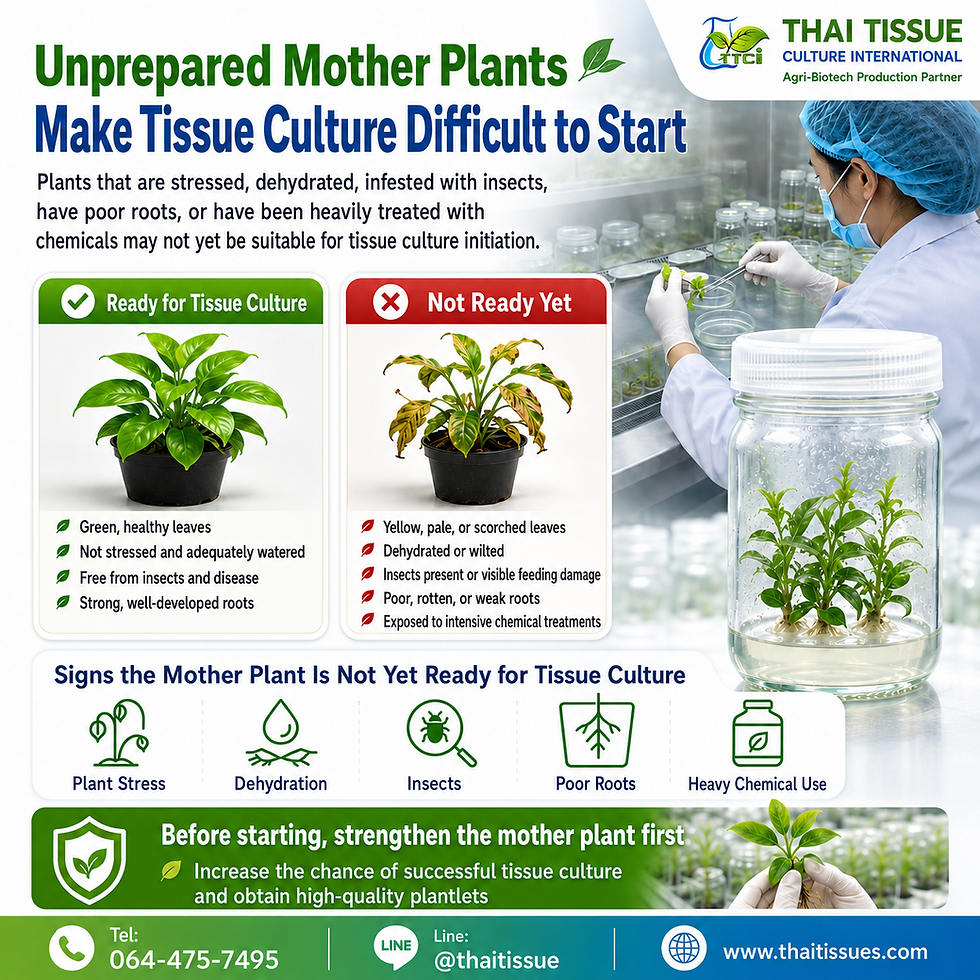
The reason is simple: the input is living plant material. Each species, cultivar and mother plant may respond differently. Some plants initiate easily, some brown quickly, some root slowly, some arrive with stress from their previous environment and some carry latent contaminants that become visible only after culture begins. Production therefore requires evaluation, selection and adjustment rather than keeping every unit merely to make the number look complete.
Controlled does not mean variability-free
A laboratory can control workspace hygiene, media, light, temperature, subculture intervals and monitoring procedures. These controls improve consistency, but they do not make all plants biologically identical. Cassells (2012), in a Methods in Molecular Biology chapter on pathogen and biological contamination management, reflects the scientific reality that plant tissue culture used for research and commercial micropropagation still requires active management of biological risk.
When a customer expects 100 initiated vessels to become 100 deliverable vessels, that expectation may conflict with the nature of biological production. A responsible laboratory should explain that the goal is not to promise perfect conversion of every unit. The goal is to design the initiation plan, monitor the process, select suitable material and deliver plantlets that meet quality criteria.
Why transparency matters more than attractive numbers
If risk is not discussed early, customers may see every rejected vessel as pure loss. In real production, rejecting a portion of the batch may protect the quality of the remaining lot. Herman (2017) frames plant tissue culture contamination as both a challenge and an opportunity, which supports a more professional view: detected risk can become useful decision-making information.
From a business perspective, the better question is not only “will we get every unit?” It is “how much starting material should be initiated to reach the target responsibly?” and “what quality checkpoints define a plantlet as ready?” These questions create a more realistic plan and reduce misunderstanding between the laboratory and the customer.
How to communicate this professionally
A useful message is: “Tissue culture is a controlled process, but biological variability still has to be managed professionally.” This tells customers that the laboratory is not avoiding responsibility. It is setting expectations that match plant biology.
With that understanding, the conversation moves away from a rigid 100% expectation and toward better planning: selecting mother plants, initiating more than one set, defining checkpoints and agreeing on delivery criteria.
If you are planning commercial tissue culture production, Thai Tissue Culture International can help evaluate crop feasibility, estimate responsible initiation volume and design a production plan that communicates biological risk clearly from the beginning.
References
- USDA Agricultural Research Service. (1999). Micropropagation system. In Vitro Cellular & Developmental Biology - Plant, 35, 275-284. https://www.ars.usda.gov/ARSUserFiles/4630/InVitro/10.%20In%20Vitro%20-%20Plant%2035%20275-284%20%281999%29%20Microprop%20system.pdf
- Cassells, A. C. (2012). Pathogen and biological contamination management in plant tissue culture: phytopathogens, vitro pathogens, and vitro pests. Methods in Molecular Biology, 877. https://pubmed.ncbi.nlm.nih.gov/22610620/
- Herman, E. B. (2017). Plant tissue culture contamination: challenges and opportunities. Acta Horticulturae, 1155, 231-238. https://www.ishs.org/ishs-article/1155_33/


Comments