

Tissue Culture Does Not Begin in a Bottle: It Begins with a Healthy Mother Plant
- นภสร ตาปะสี
- 1 day ago
- 5 min read

Many people assume that the success of plant tissue culture depends mainly on the culture medium, plant growth regulators, or the technical capability of the laboratory. In reality, the starting point is even more fundamental: the mother plant.
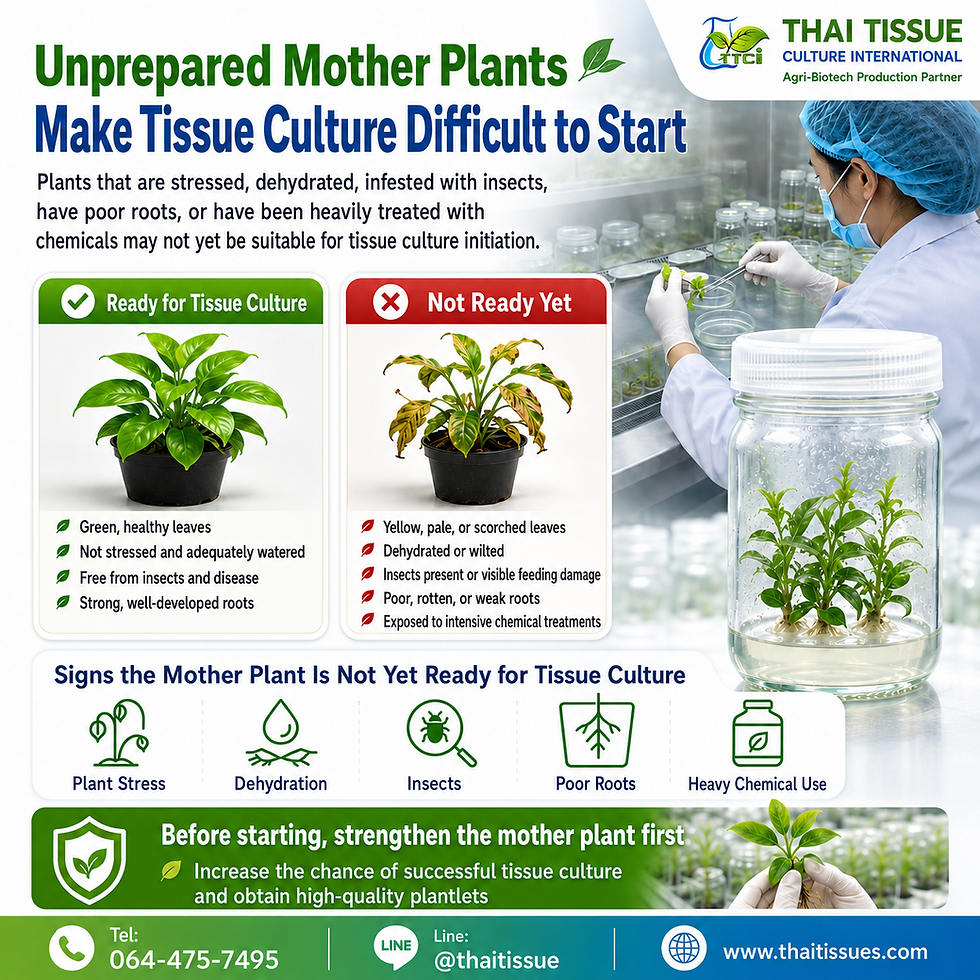
The plant material brought into the laboratory, known as the explant, is the foundation of the entire process. If the mother plant is not ready, even a well-equipped laboratory with a good formula, sterile cabinet, and standardized culture system may still struggle from the very beginning. This is because many problems are already carried inside or on the surface of the plant tissue before it ever enters the culture vessel.
A “not-ready” mother plant does not simply mean a plant that looks unattractive. It refers to a plant that is not yet suitable as a source of explants. This may include plants with insects, fungal infection, leaf spots, root rot, wounds, overly mature shoots, overly soft shoots, recent transport stress, dehydration, or heavy pruning and repotting. Plants in these conditions are often stressed, physiologically weak, and more likely to carry high microbial loads. When brought into the laboratory, they have a much higher risk of contamination. Even if surface sterilization is successful, the explant may still fail to recover or produce new shoots.
One of the most common problems is contamination, especially when mother plants are kept outdoors and exposed to rainwater, dust, splashing soil, or insect vectors. Fungi and bacteria can remain on leaf surfaces, bud crevices, nodes, stems, or even inside plant tissues as latent microorganisms. Surface sterilization alone does not guarantee complete elimination of all contaminants. For example, a rare variegated plant grown outdoors for a long time may still look healthy from the outside. But once its explant is placed on culture medium, the medium may turn cloudy within a few days, fungal threads may appear, or bacteria may spread around the explant until the entire batch has to be discarded.
The next challenge is that dirtier mother plants often require stronger sterilization. However, stronger sterilization is not always the answer. Disinfectants affect both microorganisms and plant tissues. If the treatment is too weak, contamination may remain. If it is too strong, the explant may become burned, yellow, bruised, blackened, or lose its ability to regenerate. For example, a soft, water-rich shoot that has been heavily fertilized with nitrogen may look attractive before cutting, but it can be easily damaged during sterilization and die quickly. In contrast, semi-mature young shoots from a strong, well-managed plant often tolerate sterilization better and establish more successfully in culture.
Another critical factor is the age and physiological condition of the mother plant, especially in woody plants, forest species, hardwoods, and some ornamental plants. Explants taken from old plants or highly mature branches often respond more poorly to shoot induction and rooting than younger, more juvenile tissues. For example, mature branches of some woody species may still contain axillary buds, but once introduced into tissue culture, they may fail to sprout or respond very slowly. Newly flushed shoots produced after pruning are often more active and more suitable for culture establishment.
Stressed or overly mature mother plants are also more likely to develop browning. This is especially common in woody species, forest plants, and plants with high phenolic content. When the explant is cut, phenolic compounds are released from the wounded tissue and undergo oxidation, causing the tissue to turn brown or black. If the browning is severe, the cells die before the explant can establish itself on the medium. A common example is when the explant begins turning black from the cut end and the discoloration spreads toward the bud, killing the tissue before shoot growth begins—even when the culture medium itself is suitable.
Hidden diseases are another major concern, especially viruses, bacteria, or systemic pathogens living inside the plant’s vascular system. Tissue culture can produce large numbers of plants, but if the process starts from a diseased mother plant without proper disease elimination techniques, such as meristem culture or diagnostic testing, it may simply multiply the problem on a larger scale. For example, if a mother plant with abnormal mosaic leaves or stunted growth is used for production without screening, the resulting plants may not be high-quality plantlets. They may carry the same problem forward into the next production cycle.
This is why mother plant preparation before laboratory work should never be overlooked. A good practice is to isolate and maintain the mother plant for around two to four weeks in a clean greenhouse or controlled area. This helps reduce dust, insects, soil splash, and visible disease pressure while allowing time to observe possible latent symptoms. The plant should be nourished properly, but not pushed into producing overly soft, water-rich shoots. Ideally, it should be encouraged to produce healthy new growth before explants are collected.
For example, if a customer sends a rare variegated foliage plant or woody plant for tissue culture production, the laboratory may recommend resting the plant first instead of cutting it for culture immediately. This allows the plant to recover from transport stress and produce new shoots that are more suitable for sterilization and establishment.

From a business perspective, evaluating the mother plant before accepting full production helps reduce risk for both the laboratory and the customer. If the mother plant is healthy, maintained under greenhouse conditions, and producing suitable new shoots, trial sterilization and culture establishment can begin more smoothly. But if the plant has insects, leaf spots, fungal problems, overly mature branches, or extremely limited plant material, the risks should be clearly communicated. In such cases, it is safer to begin with a small trial before moving toward large-scale production.
This approach also helps customers understand that delays or multiple rounds of testing are not signs of slow laboratory work. They are necessary steps to improve the chance of long-term success.
In summary, successful tissue culture does not begin inside a glass bottle. It begins with a clean, healthy mother plant that is physiologically ready to provide suitable explants. A well-prepared mother plant makes sterilization easier, reduces contamination, supports better establishment, encourages faster shoot growth, and lowers the cost of early-stage failure.
On the other hand, if the mother plant is not ready, its problems will enter the laboratory from day one: hidden contamination, tissue browning, poor shoot response, and diseases that may continue into the production line.
The key message for both producers and customers is simple: a good medium can help a great deal, but a good mother plant is what makes tissue culture truly possible from the start.
✨ channel for ordering ✨
Facebook Fanpage : ไทยทิชชู – ต้นไม้เพาะเนื้อเยื่อ ( Inbox 📩)
TikTok Shop : https://www.tiktok.com/@thaitissueshop
Shopee : https://shopee.co.th/thaitissue
🌱Other Contacts🌱
☎️ : 06-4475-7495 , 08-8629-4513
Line OA : https://lin.ee/UQFnpoN
Website : https://www.thaitissues.com/


Comments