

Secrets in a Glass Bottle! The World of Plant Tissue Culture
- นภสร ตาปะสี
- 23 hours ago
- 3 min read

In an era of rapidly advancing agricultural technology, Plant Tissue Culture has become a cornerstone technology for enhancing the efficiency of plant variety production.
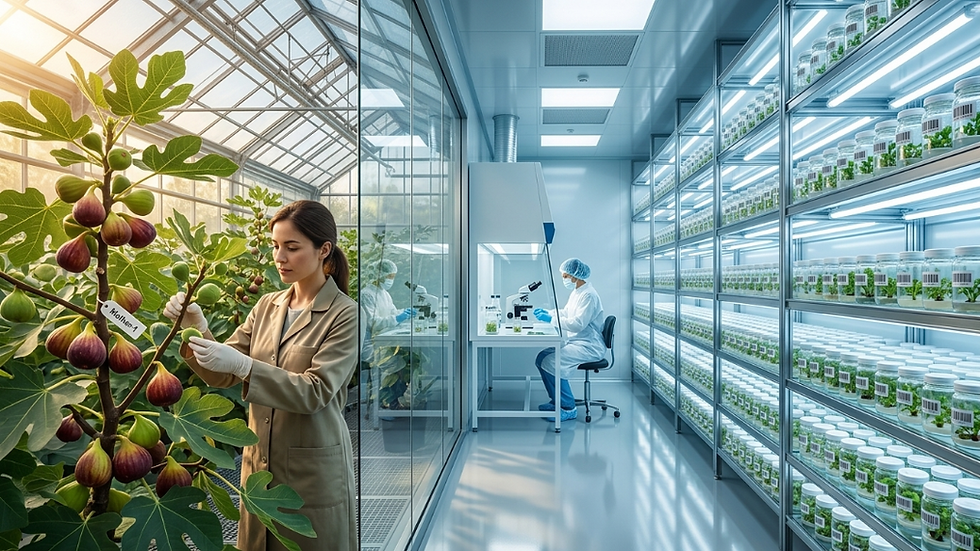
This technique involves taking small fragments of a plant—such as young shoots, leaves, or meristematic tissues—and culturing them in a strictly controlled, sterile environment within a laboratory.
Inside these glass bottles or culture vessels, there is a synthetic medium containing plant hormones and nutrients that allow the tissue to grow into a large number of plantlets within a short period.
This technology is utilized by Thai Tissue Culture International Co., Ltd. to produce high-quality plant varieties for agriculture and economic crop businesses.

What is Plant Tissue Culture?
Plant Tissue Culture is a method of taking a part of a plant—such as a leaf, stem, bud, or root—and cultivating it in a controlled, sterile environment. The plant parts are placed in a culture medium containing nutrients, sugar, vitamins, and plant hormones.
Under optimal conditions, the plant tissue can grow and develop into a new plant that possesses identical genetic characteristics to the mother plant in every way.
Therefore, this method is considered a vital technology that enables farmers and researchers to produce massive quantities of plant varieties in a very short time.
Steps of Plant Tissue Culture
Generally, the process of plant tissue culture consists of the following main steps:
Selection of the Mother Plant: Choose plants with desirable traits, vigor, and freedom from disease to ensure high-quality offspring.
Preparation of the Explant: Parts of the plant, such as leaves, shoots, or buds, are cut into small pieces to be used for cultivation.
Sterilization: The plant parts are cleaned and disinfected to prevent contamination from fungi and bacteria.
Inoculation into Synthetic Medium: The tissue fragments are placed into glass bottles containing a culture medium consisting of nutrients, hormones, and sugar to stimulate growth.
Multiplication of Plantlets: Once the tissue begins to grow, it can be divided to multiply the number of plantlets from a single piece of tissue.
Acclimatization and Transplantation: Once the plantlets are strong enough, they are removed from the glass bottles to undergo an acclimatization process before being planted in soil or actual fields.

Advantages of Plant Tissue Culture
The advantages of this method include:
🌱 Rapid multiplication of plant varieties.
🧬 100% identical genetic traits to the mother plant.
🦠 Disease and pest-free plants.
🌿 Ability to produce large quantities of plants in a limited space.
🌾 Enhanced quality and agricultural yield.
Popular Plants for Tissue Culture
Currently, many types of plants are popularly propagated through tissue culture, such as:
Bananas
Orchids
Sugarcane
Cassava
Pineapples
Various flowering and ornamental plants
These plants can be produced in large quantities in a short time with consistent quality.
Plant Tissue Culture is a scientific technology that enables rapid, high-quality, and disease-free plant propagation. The tiny world inside a glass bottle is like a laboratory full of potential for developing the future of agriculture.
From just a single small piece of tissue, thousands of plantlets can grow. This is the "Secret in a Glass Bottle" that is transforming the world of modern agriculture.
This article was prepared by Thai Tissue Culture International Co., Ltd., experts in plant tissue culture and the production of high-quality plant varieties to support Thailand's agriculture and commercial plant industries.

✨ช่องทางการสั่งซื้อ✨
Facebook Fanpage : ไทยทิชชู – ต้นไม้เพาะเนื้อเยื่อ ( Inbox 📩)
TikTok Shop : https://www.tiktok.com/@thaitissueshop
Shopee : https://shopee.co.th/thaitissue
🌱Other Contacts🌱
☎️ : 06-4475-7495 , 08-8629-4513
Line OA : https://lin.ee/UQFnpoN
Website : https://www.thaitissues.com/


Comments