

Philodendron ‘Black Cardinal’: When Dark Foliage Becomes a Product of Design, Not Chance
- นภสร ตาปะสี
- May 2
- 4 min read

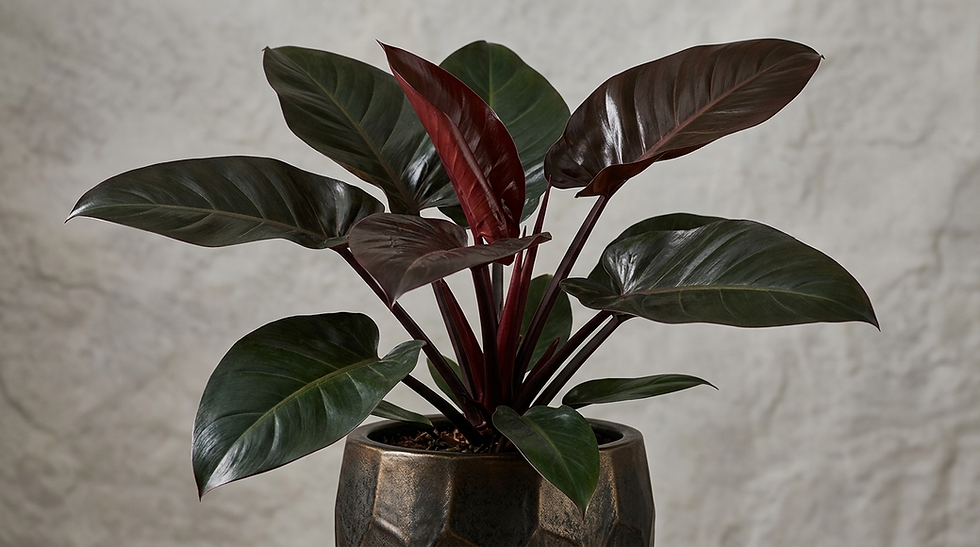
Philodendron ‘Black Cardinal’ should never be reduced to simply being a nice-looking dark foliage plant. Its real appeal lies in the fact that it is not an accident of nature, but an intentional result of breeding. This hybrid philodendron in the Araceae family was developed to combine thick glossy leaves, compact self-heading growth, durability, and an unusually deep color palette. New leaves emerge in tones of brick red, burgundy, or reddish purple before gradually maturing into dark green-black or nearly black foliage, while the stems and petioles continue to carry darker tones. The effect is restrained, rich, and unmistakably elegant.

The important point from the beginning is that Black Cardinal is not a natural species taken directly from the rainforest. It is a hybrid cultivar, and that changes the whole way it should be understood. Rather than telling its story as though it were a rare forest plant, it makes far more sense to tell it as a plant shaped through breeding design. U.S. plant patent records make that clear: it was created in Florida through a breeding program with a specific goal—producing a compact, durable philodendron with broad, thick leaves and the darkest possible ornamental character. In that way, it captures a central idea in modern ornamental horticulture: a plant must not only be beautiful, but also practical, stable, and suitable for commercial production.
Its parentage helps explain that strength. Black Cardinal emerged from a breeding program involving several philodendron species, including P. wendlandii, P. hastatum, P. erubescens, P. imbe, and P. fragrantissimum. That gives it a more complex horticultural identity than many trend-driven plants that are remembered only for rarity or variegation. What makes Black Cardinal special is the way it brings several qualities together at once—deep color, solid structure, thick foliage, and strong performance in containers. It is not beautiful because it is rare. It is beautiful because it was carefully built to succeed.
Its growth habit is a major part of that success. Black Cardinal is self-heading, which means it grows as a compact clump rather than as a climber. It stays upright, forms a dense crown, and does not need a pole or vertical support to look complete. That makes it especially useful in modern interiors, where people often want a plant that looks finished and structured without requiring constant management. In a decorative pot on the floor, it can immediately function as a strong visual anchor in a room.
Its most memorable feature, however, remains its color. But even here, the beauty lies not in flat darkness, but in variation. New growth opens in rich red or wine tones, while older foliage deepens into green-black or very dark reddish shades. That creates a living contrast within the plant itself. The eye reads the overall effect as dark, but the depth comes from multiple layers of pigment rather than from one uniform shade. That is part of what makes Black Cardinal feel so refined.
The science behind that color matters too. What we often describe as black foliage is usually not truly black in a pigment sense, but a visual result of red, purple, brown, and deep green tones overlapping. This is why Black Cardinal changes character depending on light and leaf age. Too little light can make it darker but slower. Good indirect light gives it the best balance of color, growth, and structure. Harsh direct exposure, however, can damage the leaves or flatten the beauty of the tones.
It is also more scientifically useful than many people realize. Research has shown that gibberellic acid (GA3) can induce flowering in Black Cardinal within about six months, and that the inflorescence shows thermogenesis. While flowers are not its selling point in the ornamental market, this matters enormously in breeding terms. It means that the plant is not just a decorative endpoint, but also a useful genetic resource for future hybrid development.
Commercially, that value increases even further because Black Cardinal can be propagated not only by cuttings but also through tissue culture. This is a major advantage in today’s plant industry. A plant that combines visual appeal with production consistency is far better positioned for large-scale nursery use. Black Cardinal sits in exactly that space: distinctive enough to feel special, yet stable enough to fit into systematic production.
Like any philodendron, though, it still depends on proper care. It needs an airy, well-drained substrate, careful watering, and protection from overly wet conditions. Dense, waterlogged soil can lead to root rot, while imbalance in the environment can invite pests. It also contains calcium oxalate crystals, which means it can irritate skin or be harmful if chewed by pets or children.
Ultimately, Philodendron ‘Black Cardinal’ is one of the strongest examples of the modern ornamental plant shaped by intention rather than wild rarity. It brings together dark color, strong form, indoor suitability, and commercial potential in a single plant. For anyone who appreciates beauty that feels quiet but powerful, it stands as proof that subtle depth can be just as striking as any dramatic collector trend.
Channel for ordering
Facebook Fanpage : ไทยทิชชู – ต้นไม้เพาะเนื้อเยื่อ ( Inbox 📩)
TikTok Shop : https://www.tiktok.com/@thaitissueshop
Shopee : https://shopee.co.th/thaitissue
🌱Other Contacts🌱
☎️ : 06-4475-7495 , 08-8629-4513
Line OA : https://lin.ee/UQFnpoN
Website : https://www.thaitissues.com/



Comments