

Golden Serrated Philodendron: When Modern Foliage Plants Win Through Design, Not Just Beauty

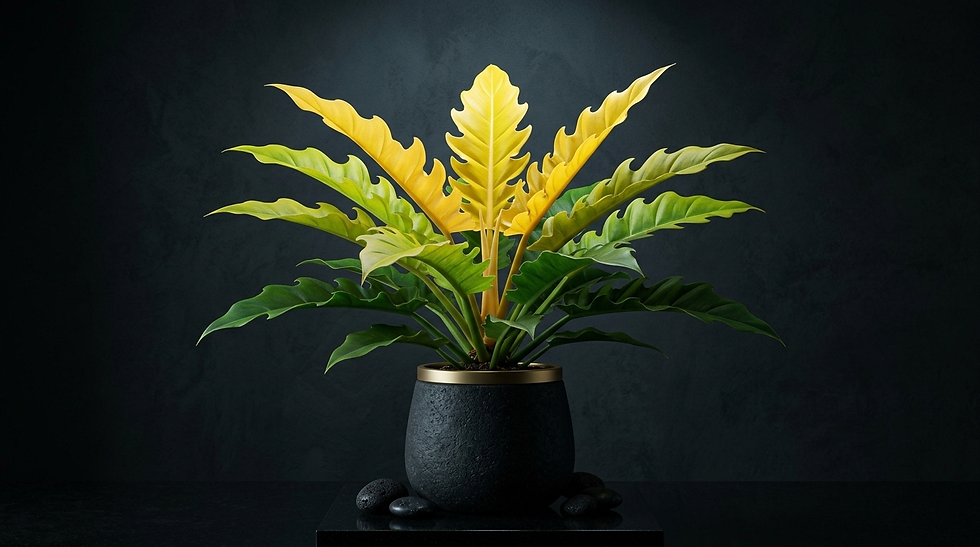
The golden serrated philodendron is one of the clearest signs of how the ornamental plant market has changed. It does not rely on dramatic variegation, and it does not need an exaggerated or bizarre form to stand out. Instead, it wins through two things: color and shape. Its leaves are long and slender, edged with deep serrations that resemble saw teeth or crocodile skin. New growth often appears in shades of golden yellow, lime, or lightly bronzed orange before gradually shifting into green as the leaves mature. That natural progression gives the plant a layered visual quality that ordinary green foliage rarely achieves.

What makes it especially worth discussing is that it represents a new kind of ornamental appeal. This is not simply a “beautiful golden plant.” It is better understood as a product of cultivar design. In the market, it appears under several different names—Golden Saw, Golden Crocodile, Golden Saw Crocodile, Ring of Fire Gold, and Neon Ring of Fire among them. That range of names suggests that the market is still actively shaping how this plant is identified and understood. The most honest way to describe it, then, is as a group of commercial golden, serrated philodendrons rather than as a clearly established wild taxonomic species.
That uncertainty actually makes the story more interesting. In the ornamental world, popularity is often driven less by formal taxonomy than by how strongly a plant’s visual identity speaks to the market. Many growers and sellers connect this plant to hybrid lines involving Philodendron pinnatifidum, Philodendron melinonii, or sometimes the broader Ring of Fire and Jungle Boogie groups. Whether or not those links are ultimately resolved in scientific terms, they already tell us something important: the plant belongs to a design-driven space where shape and color matter as much as lineage.
Its likely botanical background still matters, though, because it helps explain how the plant behaves. The philodendrons most often associated with it come from tropical rainforest environments in South America, where humidity, filtered light, and airy root conditions define survival. That means even if the golden serrated philodendron now exists mainly as a commercial ornamental, its deeper instincts still come from the rainforest. It prefers loose substrate, good root aeration, steady moisture, and bright but filtered light rather than harsh, drying conditions.
Its strongest feature is still the leaf. The serrated edges give the plant a visual rhythm and movement that softer leaf forms do not have. Instead of looking calm or rounded, it looks sharp, graphic, and contemporary. Place it beside a dark green plant with rounded foliage, and it immediately feels more like a designed object than a traditional houseplant. That is exactly why its trade names are so effective—they give people an instant visual reference.
The changing color adds another layer of appeal. New leaves bring light and brightness, while mature leaves restore balance through green tones. That internal contrast is especially useful in interior styling, because it creates energy without needing variegation to do the work. In the right room, especially one with neutral or natural materials, the golden new growth can act almost like a living highlight.
Its growth habit adds flexibility. In its younger stages, it can be grown as a compact potted foliage plant. As it matures, however, and is given support, it may begin to climb and produce larger, more dramatic leaves. That makes it suitable for both smaller decorative use and larger statement planting in living rooms, cafés, or interior commercial spaces.
Commercially, it is also moving into a more modern production phase. Tissue-cultured plants are already appearing in the market, suggesting that this group has clear commercial promise, even if specific peer-reviewed protocols tied to these exact trade names are not yet firmly established. It is best to say that the market is actively bringing this plant into contemporary propagation systems, rather than overstating the formal scientific literature.
In care terms, it is not especially difficult, but it does require some awareness. Bright indirect light is ideal, because the pale new leaves can burn easily in strong direct sun. The substrate should be coarse and free draining, and the roots should never remain constantly wet. Dry air can distort new leaves, while low light can weaken both shape and color. In good conditions, though, it is a rewarding and visually distinctive plant.
Like other philodendrons, it should also be handled responsibly. It contains calcium oxalate crystals, meaning it can irritate the mouth, throat, or skin if chewed or if the sap is handled carelessly. That is not unusual for the genus, but it does mean the plant is best kept away from small children and pets.
Ultimately, the golden serrated philodendron shows that modern ornamental value is no longer built on variegation alone. It can be built just as powerfully through form, color, and breeding logic. And that is exactly what makes this plant so memorable.


Comments