

What Is the Best Acclimatization Substrate for Tissue-Cultured Plants?

Tissue-cultured plantlets should not be transferred directly from culture vessels into ordinary garden soil. Newly deflasked plants still have underdeveloped roots, leaves, and water-regulation systems. Their growing medium must therefore retain sufficient moisture around the roots while also providing enough air space to prevent oxygen deficiency and root rot.
The goal is not to choose the material with the highest water-holding capacity. The best substrate is one that maintains an appropriate balance between water and air for the specific plant being acclimatized.
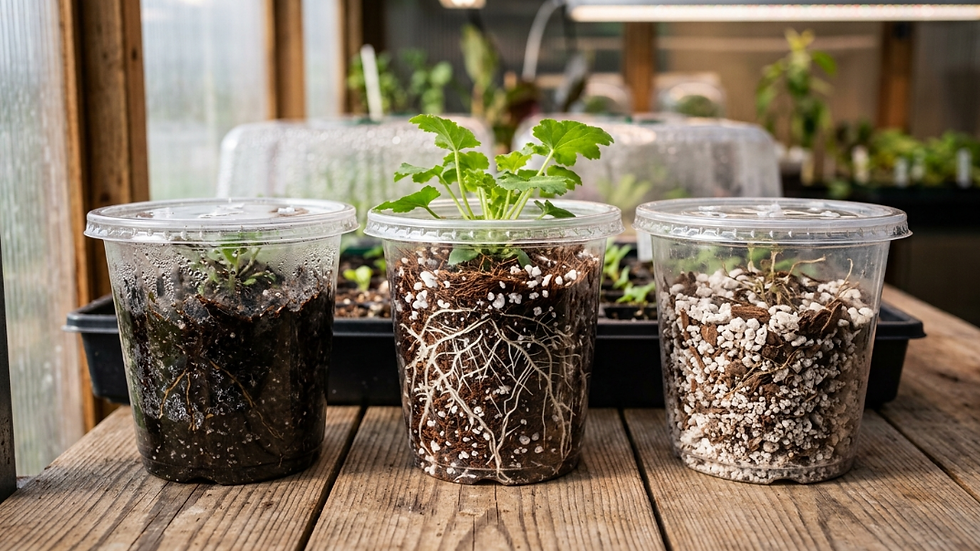
A Practical Starting Mix for Tropical Greenhouses
For greenhouse production in Thailand, a practical starting point is cocopeat combined with porous materials such as perlite or carbonized rice husk.
Cocopeat helps retain moisture and keeps the substrate lightweight, while perlite and carbonized rice husk increase pore space and improve drainage.
A trial mixture containing:
60% cocopeat
20% perlite
20% carbonized rice husk
may be suitable as a starting formulation for tropical foliage plants such as Philodendron, Monstera, Homalomena, and Syngonium.
This should be treated as a trial formula rather than a universal standard, as rooting behavior and moisture tolerance differ among species and cultivars.
Why Mixed Substrates Often Perform Better
Each substrate component offers different advantages.
Cocopeat and peat moss retain water effectively and are suitable for plantlets with small or delicate root systems. However, when the particles are too fine or watering is excessive, the substrate can remain saturated and increase the risk of basal or root rot.
Perlite, carbonized rice husk, coarse sand, and bark improve aeration and drainage. Used alone, however, they may dry too quickly for newly deflasked plants.
Research involving Philodendron ‘Pink Princess’ found that peat moss and vermiculite produced higher survival rates than perlite alone, while perlite showed a tendency to promote root elongation.
This suggests that blended substrates often provide a better balance than a single material used by itself.
Cocopeat Quality Must Be Checked Carefully
Cocopeat is widely available and well suited to tropical production systems, but its quality can vary significantly.
Some batches contain high levels of sodium, chloride, or soluble salts. These may cause root-tip burn, growth suppression, or yellowing leaves in sensitive plantlets.
Commercial growers should select cocopeat that has been properly washed and buffered and should request information on:
pH
Electrical conductivity, or EC
Sodium content
Chloride content
Moisture condition
Processing and storage history
The material should not have a fermented odor, visible fungal growth, or signs of decomposition.
Cocopeat may appear clean while still releasing excessive salts. Testing the leachate before using a new batch for large-scale acclimatization can prevent losses in sensitive young plants.
Substrate Options for Tissue-Cultured Banana
Tissue-cultured banana plantlets can be acclimatized in relatively simple, low-cost substrates.
Research has shown that a 1:1 mixture of cocopeat and carbonized rice husk can promote better plant height, pseudostem diameter, leaf area, and plant weight than either material used alone, even when survival rates among treatments are similar.
This illustrates an important principle: plant survival does not necessarily mean that a substrate is the best option.
A substrate that promotes faster root establishment and stronger growth may reduce the time required for plantlets to reach field-ready size, improving greenhouse turnover and lowering production costs.
Mixes for Fine or Limited Root Systems
Plantlets with very few roots or extremely fine root systems may benefit from a mixture with greater moisture retention.
One possible starting formula is:
50% cocopeat
25% vermiculite
25% perlite
This mixture can help maintain moisture around delicate roots while still providing some drainage.
However, it requires more careful irrigation management than formulas containing carbonized rice husk because vermiculite holds a relatively large amount of water.
During the rainy season or when acclimatizing plants that are highly susceptible to root rot, a more porous mixture may be appropriate, such as:
40% cocopeat
30% perlite
30% carbonized rice husk
This formulation may reduce the amount of time the crown and root zone remain continuously wet.
Epiphytes and Orchids Need More Air Around the Roots
Epiphytic plants and orchids require different substrate structures from most tropical foliage plants.
During the earliest stage, when the roots are still small and delicate, loosely packed sphagnum moss, coarse vermiculite, or another moisture-retentive mixture may be used.
As the roots become stronger, bark, charcoal, or chopped coconut husk should be introduced to increase aeration.
Sphagnum moss should never be compressed tightly around the plant. Although compact moss may appear to maintain ideal moisture, the interior can remain waterlogged and oxygen-poor, leading to crown and root rot.
For epiphytic species, root aeration is as important as moisture retention.

Transplanting Technique Matters as Much as the Substrate
Even a well-designed substrate will perform poorly if the deflasking and transplanting process is not handled correctly.
Agar and residual sugar should be washed completely from the roots because they can support fungal and bacterial growth outside the sterile vessel.
The substrate should be moistened before planting but should not be saturated. Plantlets should be positioned gently without compressing the medium around the roots or burying the crown too deeply.
During the initial acclimatization period, air humidity should remain relatively high. Ventilation and light exposure should then be increased gradually as the plants develop functional roots and new leaves.
Strong fertilizer should not be applied immediately after deflasking. It is safer to wait until the plant shows clear signs of new root or leaf growth before introducing a dilute nutrient solution.
If the plant has not yet produced new roots, early fertilizer application may raise the EC around the existing roots and cause additional injury rather than accelerating growth.
How to Evaluate an Acclimatization Substrate
The best substrate should not be selected on survival rate alone.
A proper comparison should include:
Survival percentage
New root formation
Root length and branching
Number of new leaves
Plant height
Stem or pseudostem diameter
Incidence of root or crown rot
Growth rate
Uniformity
Time required to reach saleable or field-ready size
For example, three substrate treatments may all achieve 90% survival, but one may produce larger root systems and reach marketable size several weeks earlier. That difference has a direct commercial value.
There Is No Universal Best Substrate
No single acclimatization substrate is ideal for every tissue-cultured plant.
The most reliable general principles are to use materials that are:
Clean
Low in soluble salts
Free from pests and pathogens
Able to retain adequate moisture
Porous enough to support root aeration
Stable during the acclimatization period
Suitable for the irrigation and climate conditions of the greenhouse
For tropical foliage plants, a practical starting trial is 60% cocopeat, 20% perlite, and 20% carbonized rice husk.
For banana, a 1:1 mixture of cocopeat and carbonized rice husk is a useful starting point.
However, commercial producers should compare at least three substrate formulations and measure not only survival but also root quality, leaf development, growth speed, disease losses, and the time required for plants to reach the delivery standard.
The best substrate is not simply the one that keeps the plantlets alive. It is the one that helps them develop strong roots, adapt quickly, and become healthy, uniform, market-ready plants with the lowest practical loss rate.
✨ channel for ordering ✨
Facebook Fanpage : ไทยทิชชู – ต้นไม้เพาะเนื้อเยื่อ ( Inbox 📩)
TikTok Shop : https://www.tiktok.com/@thaitissueshop
Shopee : https://shopee.co.th/thaitissue
🌱Other Contacts🌱
☎️ : 06-4475-7495 , 08-8629-4513
Line OA : https://lin.ee/UQFnpoN
Website : https://www.thaitissues.com/


Comments