

Same Plants, Different Colors: A Deep Dive into the Science Behind "Variegated Plants"—When Abnormality Becomes Art
- ชนิญญา เหล่าหมวด
- Jan 8
- 3 min read

In the world of botany, green is the symbol of perfection and life. However, in the realm of collectors, the true allure lies in "imperfection"—manifested in the white, yellow, or pink patterns painted across foliage, known as "Variegated Plants."
The intriguing question is: Why do plants of the same species, with identical starting genetics, exhibit such vastly different physical characteristics? And why have these natural phenomena become such precious treasures sought after by collectors worldwide? This article will take you on a journey to explore the origins of variegation at the cellular level, allowing for a deeper understanding of this "Beauty in Imperfection."
The Physiology of Green and the Origins of Variegation

To understand the mechanism behind variegated plants, we must revert to the fundamentals of plant existence. Typically, plants possess intracellular organelles called "Chloroplasts," which contain the green pigment known as "Chlorophyll." These function like food production factories via the process of photosynthesis.
Variegation is, in reality, a physiological abnormality that arises when certain parts of the plant's cells lack chlorophyll or are unable to produce green pigment normally. This causes those specific areas to reveal the underlying tissue color—which may be white, cream, or yellow—resulting in distinctly contrasting patterns across the leaf surface.
3 Pathways to Variegation (The Origins of Variegation)
Variegation does not stem from a single cause; rather, it can be categorized into three primary types, each affecting pattern stability and genetic transmission in distinct ways.
1. Chimeral Variegation

This is the most common cause found in high-value collectible plants, such as Monstera Borsigiana Albo. This phenomenon results from a mutation at the level of the meristematic tissue (Somatic Mutation), causing a single plant to possess two distinct sets of genetic codes simultaneously, a condition known as a "Chimera."
One group of cells is capable of producing chlorophyll normally (green), while the other group cannot (white/yellow). The arrangement of these two cell groups occurs randomly, creating unique patterns on every leaf. This is also the reason why this type of variegation is unstable; it can "revert" (turn fully green) or become "ghost" (turn fully white) at any moment.
2. Structural Variegation
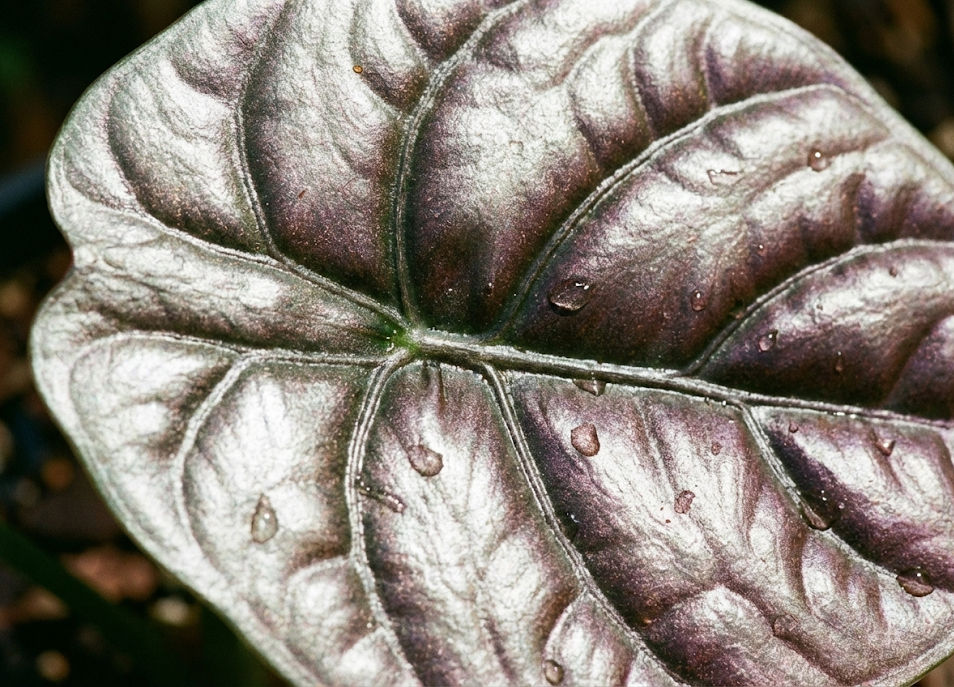
This type of beauty is frequently found in families such as Alocasia, Begonia, or Scindapsus (Satin Pothos). It does not arise from a lack of pigment but rather from the physical structure of the leaf's surface layer, which features
"air pockets" interspersed between the epidermis and the underlying tissue.
When light strikes the leaf, it refracts and reflects back as a shimmering Silvery sheen. This form of variegation is considered a stable species characteristic and will not revert or disappear.
3. Viral Variegation

Historically, the mesmerizing patterns of tulips during the 17th century (Tulip Mania) were caused by an infection of the Mosaic Virus. The virus invades and destroys the chlorophyll production process, resulting in speckled or streaked variegated patterns.
Although visually exotic and beautiful, botanically speaking, this is a pathological condition (sickness). It can weaken the plant and poses a risk of spreading the infection to other plants in the garden. Consequently, modern collectors usually avoid variegation caused by this factor, except in certain specific species where it is accepted.
The Price to Pay for Fragility
The reason variegated plants are so rare in the wild is not a matter of coincidence, but rather a result of "Natural Selection."
The white areas on a leaf act as a burden to the plant; they are parts that consume nutrients but cannot photosynthesize to generate energy. In a natural forest, plants with less green surface area inevitably grow slower and are defeated in the intense competition for sunlight.
The variegated plants we admire today are essentially "Survivors" discovered by humans and nurtured under optimized environments. Cultivating variegated plants is, therefore, not just about planting a tree; it is about preserving a genetic miracle that nature created—intentionally within the accidental.
Thai Tissue understands the value and complexity of these genetics. We are committed to selecting and propagating variegated plants using state-of-the-art Tissue Culture technology, ensuring that this rare beauty is delivered to your hands in the most perfect and healthy condition.
🌱Other Contacts🌱
☎️ : 06-4475-7495 , 08-8629-4513
Line OA : https://lin.ee/UQFnpoN
Website : https://www.thaitissues.com/
✨Channel For Ordering✨
Facebook Fanpage : ไทยทิชชู – ต้นไม้เพาะเนื้อเยื่อ ( Inbox 📩)
TikTok Shop : https://www.tiktok.com/@thaitissueshop
Shopee : https://shopee.co.th/thaitissue


Comments