

Rainy Season and Tissue Culture: Why the Risk Often Begins with the Mother Plant

Plant tissue culture does not necessarily need to stop during the rainy season. If the plantlets are already established inside sterile culture vessels, routine subculture, shoot multiplication, or rooting can usually continue as normal in a well-controlled laboratory environment. The step that should be approached with the most caution is starting a new culture line from external mother plants—such as collecting shoot tips, axillary buds, nodes, rhizomes, or other plant parts from field-grown material during periods of heavy rainfall.
The reason is simple: during the rainy season, mother plants often carry a higher microbial load than usual. Fungi, bacteria, spores, and latent microorganisms may be present both on the plant surface and inside the plant tissue before the explant ever enters the sterilization room.

Rainy conditions create an ideal environment for microorganisms around the mother plant. High humidity, prolonged leaf wetness, rain splash from soil, and insect vectors all increase the chance that microbes will settle on leaves, stems, nodes, buds, and wounds. Even when the mother plant looks green and healthy from the outside, its surface may be carrying far more microorganisms than during the dry season. For example, a plant kept outdoors through several consecutive rainy days may have fungal spores hidden around leaf axils or nodes before any visible disease symptoms appear. Once this material enters a culture vessel, those microbes may develop very quickly.
Several research groups have reported that collecting explants during the rainy season can increase the risk of contamination, especially in plants with nodes, sheaths, rhizomes, or plant structures where microorganisms can easily hide. Bamboo, banana, bulb crops, rhizomatous plants, and field-grown species are particularly vulnerable. In bamboo, for instance, some reports have linked rainy-season collection with higher levels of endogenous contamination, meaning contaminants hidden inside the tissue. In potato, some studies have also found very high contamination rates when culture establishment was initiated during periods of frequent rainfall, even after surface sterilization was applied.
The most difficult problem is not only surface contamination, but also internal or endophytic contamination. Common sterilization agents such as alcohol or sodium hypochlorite can reduce surface microbes to some extent. However, if microorganisms are hidden inside vascular tissues, intercellular spaces, bud crevices, or internal wounds, surface sterilization may not remove them completely. A common example is a culture bottle that appears clean during the first three to five days, but after two or three weeks begins to show bacterial slime, cloudy medium, or stalled tissue growth. This is often a sign of latent contamination that appears slowly after culture initiation.
Once contaminated explants are placed on culture medium, the problem becomes more serious. Tissue culture medium contains sugar, minerals, vitamins, and plant growth regulators designed to support plant cell growth. Unfortunately, the same nutrient-rich environment is also highly favorable for fungi and bacteria. Even a small amount of contamination can multiply rapidly inside the vessel. For example, an explant with bacteria hidden near the node may cause the surrounding medium to become cloudy within a few days, preventing shoot growth and killing the tissue before it reaches the multiplication stage.
The rainy season also makes surface sterilization more difficult. When explants carry a heavier microbial load, laboratories may need to increase the concentration of disinfectants, extend soaking time, or add more washing steps. However, stronger sterilization does not always lead to better results. Harsh sterilization can damage plant tissue, causing bruising, yellowing, browning, delayed shoot growth, or complete explant death. For example, soft, water-rich shoots produced during wet weather may look fresh at the time of cutting, but once exposed to stronger disinfectants, they can bruise easily and develop browning after being placed on culture medium.
From a business perspective, rainy-season risk is not only about having more contaminated bottles. It also means higher production costs. A contaminated batch wastes culture medium, vessels, labor, shelf space, monitoring time, and production opportunity. If sterilization has to be repeated several times, the production timeline becomes longer and plant numbers become harder to predict. For example, accepting a large production order from outdoor mother plants during a period of heavy rainfall without a trial phase may lead to an entire batch being lost to contamination, forcing the process to restart from mother plant preparation.
However, if it is necessary to begin new tissue culture work during the rainy season, the risk can be reduced through proper mother plant preparation. Mother plants should be moved into a rain-protected greenhouse or controlled area for about two to four weeks. Leaf wetness should be minimized, soil splash should be reduced, and plants should be screened for disease and insects. The goal is to encourage strong new shoots before explants are collected.
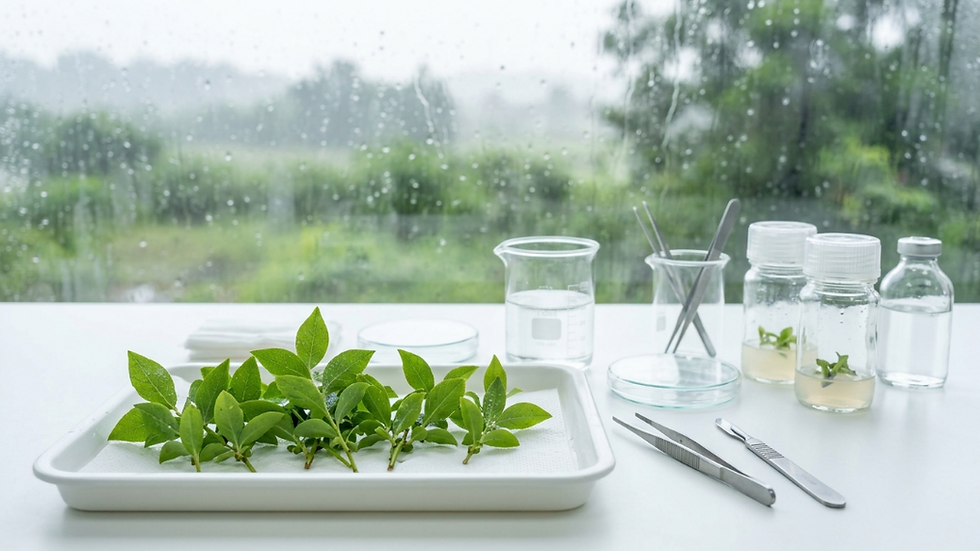
After that, it is safer to begin with a small pilot batch, such as 20–50 explants per variety, to evaluate contamination rate, survival, shoot response, and browning before scaling up to full production. This allows the laboratory and customer to make decisions based on actual response rather than assumptions.
For commercial production, it is important to separate which stages are most at risk during the rainy season. Subculture from already sterile in vitro plantlets can usually continue as normal if laboratory control is strong. The higher-risk steps are collecting explants from external mother plants, surface sterilization for new culture establishment, and acclimatization after deflasking under high humidity. For plants such as bamboo, banana, bulb crops, or forest species collected from open fields, a quarantine culture period and monitoring for latent contamination for at least two to four weeks are highly recommended before moving the material into the main production system.
In summary, the reason it is risky to start tissue culture from mother plants during the rainy season is not because the laboratory cannot operate. It is because external mother plants carry a higher-than-usual risk of contamination, both on the plant surface and inside the tissue. Sterilization becomes more difficult, stronger treatments may be required, and explant survival can be affected.
If tissue culture must be initiated during the rainy season, the best approach is to prepare mother plants in a protected greenhouse, select only healthy material, begin with a pilot batch, and evaluate the results systematically. In plant tissue culture, the cleanliness of the starting material often determines the success of the entire production line.
✨ channel for ordering ✨
Facebook Fanpage : ไทยทิชชู – ต้นไม้เพาะเนื้อเยื่อ ( Inbox 📩)
TikTok Shop : https://www.tiktok.com/@thaitissueshop
Shopee : https://shopee.co.th/thaitissue
🌱Other Contacts🌱
☎️ : 06-4475-7495 , 08-8629-4513
Line OA : https://lin.ee/UQFnpoN
Website : https://www.thaitissues.com/


Comments