

Exporting Tissue-Cultured Plants: What Documents and Preparations Are Required?

The international shipment of tissue-cultured plants has become increasingly popular because plantlets produced under sterile conditions are lightweight, require relatively little shipping space, and present a lower risk of carrying soil-borne pests than conventionally acclimatized plants.
However, tissue-cultured plantlets are still classified as plants for planting. This category is subject to strict phytosanitary and quarantine controls in many countries. Exporters must therefore review the requirements of each destination country carefully before accepting an order or beginning production.

Check the Destination Country’s Import Requirements First
The most important step before starting an export project is to ask the importer to confirm the destination country’s requirements and obtain an Import Permit where required.
Import conditions may differ according to the plant species, country of origin, packaging method, and form of the product. Some countries accept only sealed in vitro plantlets growing on sterile agar medium, while others may require the medium to be removed before shipment. Certain destinations may also require laboratory testing for specific pathogens.
For example, Australia and the United States apply different import conditions depending on the plant species and how the plantlets are prepared and packaged. A procedure accepted by one country should never be assumed to be acceptable in another.
The Import Permit should be reviewed before production and shipment planning begin. It may specify:
Permitted botanical names
Approved plant quantities
Acceptable forms of planting material
Packaging requirements
Required treatments
Laboratory testing requirements
Additional declarations for the phytosanitary certificate
Approved ports or inspection stations
These conditions should be treated as the primary reference for preparing the shipment.
Sterile in the Bottle Does Not Automatically Mean Disease-Free
Although tissue culture plantlets are produced under sterile conditions, this does not mean they are automatically free from every plant disease.
Viruses, viroids, and internal microorganisms may remain within plant tissues because surface sterilization mainly removes contaminants from the outside of the explant. It does not necessarily eliminate systemic pathogens already present in the mother plant.
A culture vessel may contain clear medium and show no visible fungal or bacterial growth while the plantlet still carries a virus or another internal pathogen.
Claims such as virus-tested, virus-free, or disease-free should therefore be supported by appropriate laboratory testing. The required method will depend on the crop and target pathogen and may include ELISA, PCR, RT-PCR, or other validated diagnostic techniques.
Essential Export Documents
Documentation plays a major role in whether an international plant shipment is cleared successfully. The exact requirements vary by destination, but exporters commonly need to prepare the following documents:
Phytosanitary Certificate or e-Phyto
Commercial Invoice
Packing List
Air Waybill
Customs declaration and supporting export documents
Import Permit from the buyer, where required
CITES documentation, where applicable
Certificate of Origin, if requested
Laboratory test reports or health declarations, where required
Additional Declaration, when specified by the importing authority
All documents must contain consistent information. The scientific name, cultivar name, quantity, consignee, package count, product description, and shipment details should match across the Import Permit, Commercial Invoice, Packing List, Phytosanitary Certificate, Air Waybill, and package labels.
For example, if the botanical name on the Commercial Invoice does not match the name approved on the Import Permit—even when both descriptions refer to what the seller believes is the same plant—the shipment may be held for inspection or refused entry.
Trade names alone should not be used as the primary plant identification. The accepted scientific name should be included, together with the cultivar or variety name where relevant.
A suitable product description may read:
In vitro plantlets of [scientific name], cultivar [cultivar name], cultured on sterile agar medium in sealed containers, free from soil and extraneous organic matter, intended for planting and propagation.
The Role of the Phytosanitary Certificate
A Phytosanitary Certificate is one of the most important documents for exporting live plants and planting materials. It is issued by the national plant protection authority of the exporting country after the shipment has been inspected and found to comply with the importing country’s phytosanitary requirements.
In Thailand, the responsible authority is the Department of Agriculture.
The certificate may need to include specific wording requested by the destination country. This is commonly called an Additional Declaration. The declaration may confirm that the plants were produced under specified conditions, inspected for particular pests, or tested for certain pathogens.
The wording must follow the Import Permit or official import conditions exactly. Exporters should not create or paraphrase an Additional Declaration without confirming it with the relevant plant quarantine authority.
Where electronic phytosanitary certification is accepted, an e-Phyto may be transmitted directly between the authorities of the exporting and importing countries. However, the exporter and importer should still verify whether the destination requires any original paper documents to accompany the shipment.
CITES Requirements Must Be Checked by Species
Certain plants are regulated under the Convention on International Trade in Endangered Species of Wild Fauna and Flora, or CITES. This may include orchids, cacti, cycads, and other protected or rare plant species.
In vitro specimens of some CITES-listed plants may qualify for specific exemptions when they are transported in sterile containers under defined conditions. However, these exemptions do not apply universally to every species or every form of shipment.
The regulatory status may change once plants are removed from their sterile vessels or acclimatized in a nursery. Plants that are exempt while sealed in vitro may require CITES permits after deflasking.
Exporters must therefore verify:
The accepted scientific name
The CITES appendix in which the species is listed
Whether artificially propagated in vitro material qualifies for an exemption
Whether an export permit is required
Whether the importing country requires an additional import permit
Whether the delivery form changes the permit requirement
The CITES status should be checked for every species before shipment rather than inferred from the plant’s common name or family.
Packaging Must Protect Both the Plantlets and Sterility
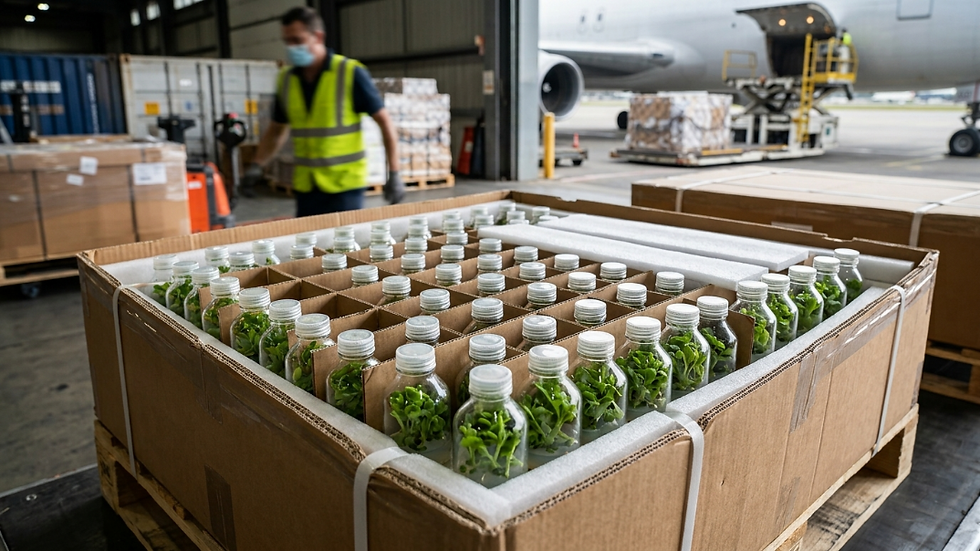
Packaging is essential for preserving plant quality during transportation. Culture vessels should be sealed securely, free from cracks, and strong enough to remain closed throughout the journey.
The agar medium should remain stable and should not detach, move around the vessel, or cover the leaves and shoot tips. Repeated impact during transport can loosen the agar, bruise plantlets, break roots, damage growing points, or loosen the container caps.
Each vessel should be held firmly in place with appropriate cushioning so that containers do not collide directly. Suitable materials may include foam, corrugated dividers, protective paper, molded supports, or other shock-absorbing packaging.
For glass vessels containing Monstera, Philodendron, or similar ornamental plants, every bottle should be individually separated and supported at the base, sides, and top of the box.
The outer package may be marked clearly with wording such as:
LIVE IN VITRO PLANTLETSSTERILE AGAR MEDIUMNO SOILHANDLE WITH CAREKEEP UPRIGHT
These labels help logistics personnel and inspection officers understand the nature of the shipment. However, they do not replace any legally required labels or documentation.
Temperature and Transit Time Also Matter
Even when plantlets are packed securely, their condition may deteriorate if the journey is too long or if they are exposed to unsuitable temperatures.
Tissue-cultured plantlets may experience:
Shoot elongation in prolonged darkness
Pale or yellowing leaves
Heat injury
Chilling injury
Agar softening or movement
Condensation inside the vessels
Reduced vigor after delayed clearance
The shipping route should therefore be planned around the shortest practical transit time. Direct flights or routes with reliable cargo handling are generally preferable to complicated connections that may leave the shipment waiting in warehouses for several days.
The exporter should also review weekends, public holidays, inspection-office schedules, and expected arrival times before dispatching the shipment.
The Importer Must Be Ready Before the Shipment Arrives
The importer’s preparation is just as important as the exporter’s production and packaging.
Before the shipment departs, the consignee should have:
The original or electronic Import Permit
Copies of the invoice and packing list
Air Waybill details
Phytosanitary certificate information
Customs broker or plant quarantine contact details
CITES permits, where applicable
A plan for rapid collection after inspection
Once the plants arrive, the importer should begin customs and plant quarantine clearance as quickly as possible. Delays can leave the plantlets in darkness or uncontrolled temperatures for an extended period.
A shipment may still contain living plants after several days in storage, but the plantlets may become elongated, pale, weakened, or less suitable for acclimatization.
Build an Export Compliance Matrix
Businesses that export tissue-cultured plants regularly should maintain an Export Compliance Matrix for each market.
This system may include:
Destination country
Plant species and cultivar
Import Permit requirement
Phytosanitary certificate requirement
Required Additional Declaration
Pathogen-testing requirements
CITES status
Accepted packaging format
Whether agar medium is permitted
Approved entry point
Expected transit time
Customs broker or local agent
Previous clearance history
Previous inspection issues or rejections
Maintaining this information reduces documentation errors and improves production planning, especially when several plant species are being shipped to multiple countries.
The matrix should be reviewed regularly because import regulations, approved pest lists, electronic certification systems, and permit conditions may change.
A Practical Export Workflow
A well-managed tissue culture export project generally follows this sequence:
Confirm the scientific name and cultivar.
Ask the importer to verify official import conditions.
Obtain and review the Import Permit, if required.
Check CITES and other controlled-plant regulations.
Confirm pathogen-testing and Additional Declaration requirements.
Produce and inspect the plantlets under a traceable batch system.
Prepare consistent invoices, packing lists, and labels.
Apply for the Phytosanitary Certificate or e-Phyto.
Pack the vessels securely and keep them upright.
Book an appropriate route and minimize transit time.
Send all documents to the importer before departure.
Arrange rapid customs and quarantine clearance on arrival.
Export Success Depends on Compliance as Much as Plant Quality
Exporting tissue-cultured plants is not simply a matter of placing sterile plantlets in a box and sending them overseas. It requires coordinated management of phytosanitary law, production standards, traceability, plant health, documentation, packaging, transportation, and import clearance.
When exporters verify destination-country requirements from the beginning, use correct scientific names, prepare consistent documents, confirm CITES status, and control product quality systematically, they significantly reduce the risk of the shipment being held, returned, destroyed, or refused entry.
The true measure of a successful export is not only whether the plantlets leave the laboratory in good condition. It is whether they pass inspection, reach the customer safely, and remain healthy enough to continue growing after arrival.
✨ channel for ordering ✨
Facebook Fanpage : ไทยทิชชู – ต้นไม้เพาะเนื้อเยื่อ ( Inbox 📩)
TikTok Shop : https://www.tiktok.com/@thaitissueshop
Shopee : https://shopee.co.th/thaitissue
🌱Other Contacts🌱
☎️ : 06-4475-7495 , 08-8629-4513
Line OA : https://lin.ee/UQFnpoN
Website : https://www.thaitissues.com/


Comments