

Date Palm Tissue Culture: From Selected Mother Plants to Commercial Female Plant Production

Date palm, scientifically known as Phoenix dactylifera L., belongs to the Arecaceae family. It is a dioecious plant, meaning that male and female flowers occur on separate trees. When date palms are grown from seed, growers cannot reliably determine the sex or fruit quality until the trees begin flowering, which may take several years.
Seed-derived plants are also genetically different from the mother plant. Their fruit color, size, flavor, texture, and ripening period therefore cannot be guaranteed. Tissue culture has consequently become an important technology for producing large numbers of uniform female plants from known commercial cultivars such as ‘Barhee’ and ‘Medjool’.
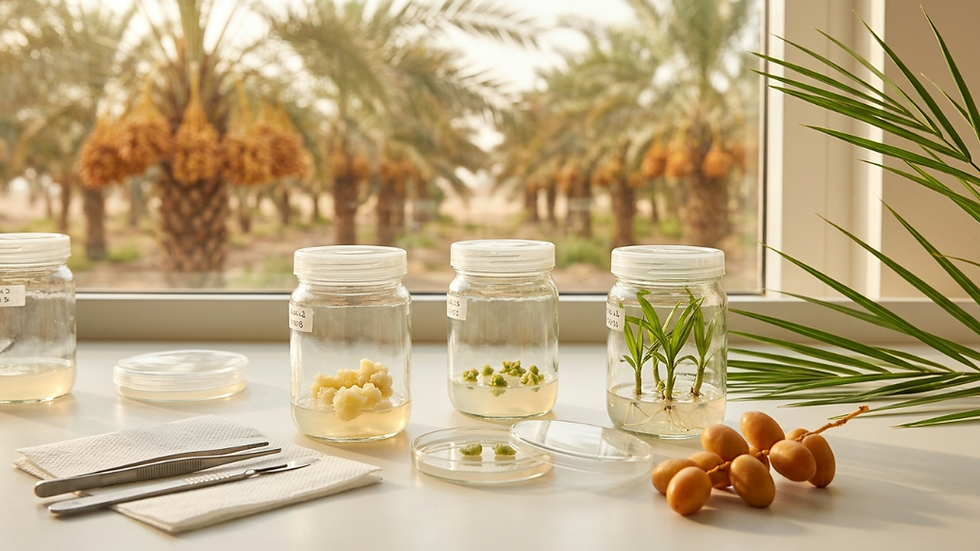
Two Main Regeneration Pathways
Commercial date palm tissue culture generally follows two main pathways: direct organogenesis and somatic embryogenesis.
Direct organogenesis involves the formation of shoots directly from buds or meristematic tissues. Its main advantage is a greater likelihood of retaining the characteristics of the mother plant because the process does not require a prolonged callus phase. However, its multiplication rate is generally lower.
Somatic embryogenesis involves producing embryo-like structures from somatic, or non-reproductive, plant cells. It can generate much larger numbers of plantlets and is therefore attractive for industrial-scale production. However, plant growth regulator levels, callus age, and the number of subculture cycles must be controlled carefully.
For example, a project requiring a limited number of elite plants with a strong emphasis on true-to-type characteristics may begin with organogenesis. An order involving tens of thousands of plants may require the development of a somatic embryogenesis system alongside it.
Selecting Explants from Verified Female Palms
Suitable starting materials include young shoots from offshoots, axillary buds, immature leaves close to the shoot meristem, and immature inflorescences.
Offshoots are widely used because their sex and cultivar identity are known from the mother palm. However, removing the growing point means that the selected offshoot can no longer continue developing into a normal independent tree. Field-grown offshoots also present a high risk of contamination and tissue browning.
For example, an offshoot collected from a ‘Barhee’ mother palm with confirmed fruit quality can be used as clonal material. However, several layers of leaves must be removed to expose the young internal shoot. This is a highly skilled procedure, and the delicate meristematic tissue can be damaged easily.
Immature Inflorescences as an Alternative Explant
Immature inflorescences are another promising source of explants. They can be collected from a palm whose sex and cultivar have already been confirmed without removing the main shoot. A single inflorescence may also be divided into several initial explants.
In some systems, immature floral tissues show less contamination and browning than shoot tissues collected from offshoots. However, the developmental stage must be selected carefully. Inflorescences that are too young or too mature may respond poorly.
In one study involving ‘Medjool’, immature inflorescences enclosed within the spathe and measuring approximately 10–15 centimeters responded more effectively in embryogenic culture than very small inflorescences under the conditions tested. However, this size range should not be applied universally without further trials, as responses may vary according to the mother palm and local growing conditions.
Culture Media and Hormonal Control
MS medium is commonly used as a basal medium for date palm tissue culture, together with sugar, plant growth regulators, and substances that help control tissue browning.
During callus induction or the development of embryogenic competence, auxins such as 2,4-D or picloram are often combined with cytokinins such as 2-iP, BA, or TDZ. Once embryogenic callus has formed, the auxin level is reduced to promote the formation and development of somatic embryos.
Research on ‘Barhee’ has shown that lower concentrations of 2,4-D may produce callus with a greater capacity to develop embryos and complete plantlets than higher concentrations. This illustrates that stronger hormone treatments do not necessarily produce better-quality cultures. Excessive levels may increase the risk of callus deterioration and off-type plants during later stages.
Controlling Browning During Culture Establishment
One of the main challenges during culture establishment is browning, which occurs when phenolic compounds released from wounded tissues become oxidized and turn the explant and culture medium brown.
Date palm tissues, particularly those collected from mature palms, can release large amounts of phenolic compounds after cutting. If browning is not controlled, the explant may die before producing shoots or callus.
Common management strategies include minimizing tissue injury, transferring explants to culture medium quickly after cutting, maintaining cultures in darkness during the initial stage, changing the medium when discoloration begins, and adding substances such as PVP, activated charcoal, glutamine, or suitable antioxidants.
Some ‘Medjool’ establishment protocols, for example, have used PVP together with activated charcoal to reduce the effects of phenolic compounds. However, activated charcoal must be used carefully because it can also adsorb plant growth regulators and alter their availability in the medium.
Root Quality Is More Important Than Plant Height
After shoots or young plantlets have developed, a strong root system must be established before deflasking. Reduced-strength MS medium combined with suitable concentrations of NAA or IBA may be used, depending on the cultivar and production system.
Plantlets selected for acclimatization should have healthy leaves, a firm basal stem, normal tissue development, and several well-developed roots. Plant height alone is not a reliable indicator of quality.
For example, a plantlet that is 12 centimeters tall but has only one root and translucent, hyperhydric leaves may have a lower survival rate than a shorter plantlet with three or four strong roots. After deflasking, the plantlets may be transferred to a porous substrate such as peat mixed with perlite. High humidity should be maintained during the initial stage and then gradually reduced as the plants adapt.
Latent Contamination and Somaclonal Variation
Two major risks that must be monitored in date palm tissue culture are latent contamination and somaclonal variation.
Internal bacteria or fungi may remain undetected during early culture stages and only become visible after several transfers to fresh medium. Somaclonal variation may arise when cultures remain in the callus phase for too long, are exposed to excessive hormone levels, or undergo too many multiplication cycles.
Some abnormalities, including unusual flowering, poor fruit set, or fruit that does not match the cultivar, may not be detectable inside the bottle or during the nursery stage. They may only become apparent after the palms reach maturity in the field.
A plant may therefore appear normal in the laboratory and greenhouse but still develop reproductive abnormalities later. Large-scale projects should consider DNA-based testing, ploidy analysis, sex-marker testing, and field evaluation before expanding production to tens of thousands of plants.

Why Commercial Development Should Begin with a Pilot Batch
Commercial protocol development should begin with pilot trials rather than an immediate guarantee of large production quantities from a newly received mother palm.
Several explant sources and developmental stages should be compared. A trial may evaluate immature inflorescences against offshoot-derived shoot tissues, direct organogenesis using TDZ or BA, and somatic embryogenesis using low concentrations of picloram or 2,4-D.
The evaluation should include contamination, browning, the number of buds or embryos produced, the percentage of normal shoots, rooting performance, and survival after deflasking.
For example, an initial pilot batch of 100–500 plants may be produced and assessed for uniformity and sex before production capacity is expanded to a full commercial scale.
Producing Reliable Female Date Palms at Commercial Scale
Date palm can be propagated through tissue culture and produced commercially, but it is a technically demanding crop that often requires a relatively long period of protocol development. Responses may vary considerably among cultivars and even among individual mother palms.
When maintaining true-to-type characteristics is the highest priority, production should begin with organogenesis and explants collected from mother palms with confirmed sex and fruit quality. When large-scale multiplication is required, somatic embryogenesis may be developed using the shortest practical callus period and the lowest hormone concentrations that still produce an effective response.
Before full commercial production begins, the cultures should be evaluated for contamination, cultivar identity, sex, genetic stability, and field performance.
The quality of tissue-cultured date palms should not be measured only by the number of plantlets produced. It should be measured by their strength, uniformity, confirmed female identity, and long-term ability to produce fruit that remains true to the selected cultivar.
✨ channel for ordering ✨
Facebook Fanpage : ไทยทิชชู – ต้นไม้เพาะเนื้อเยื่อ ( Inbox 📩)
TikTok Shop : https://www.tiktok.com/@thaitissueshop
Shopee : https://shopee.co.th/thaitissue
🌱Other Contacts🌱
☎️ : 06-4475-7495 , 08-8629-4513
Line OA : https://lin.ee/UQFnpoN
Website : https://www.thaitissues.com/


Comments