

Cactus Tissue Culture: From Areoles to Commercial Plantlet Production

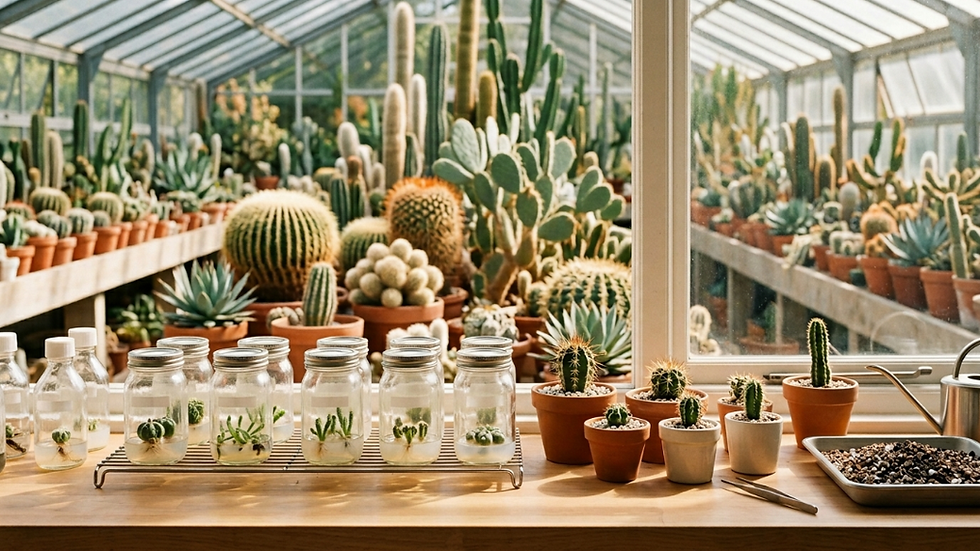
Many cactus species are well suited to tissue culture because conventional propagation can be slow and limited. Some species grow slowly, require a long time to produce offsets, generate only a small number of seeds, or produce seedlings that differ from the mother plant. Rare cacti, variegated plants, mutants, and unusual forms may also be represented by only a few mother plants.
Using small tissue sections for in vitro multiplication can therefore reduce damage to valuable mother stock and help relieve pressure from wild collection. Genera such as Mammillaria, Ariocarpus, Turbinicarpus, and Pelecyphora, for example, can benefit from tissue culture when only limited propagation material is available.
Why the Areole Matters
The most important structure for clonal cactus propagation is the areole. An areole contains dormant buds, meristematic tissue, spines, and hairs. When apical dominance is reduced, or when a tissue section containing a complete areole is cultured under suitable conditions, the hidden bud can be stimulated to develop into a new shoot.
This approach is particularly useful for commercial clonal production because the shoots arise from pre-existing buds. As a result, they are more likely to retain the characteristics of the mother plant than shoots regenerated through a prolonged callus phase.
For example, a transverse stem disc from a globular cactus can be divided so that each section contains an intact areole. When cultured with a suitable cytokinin concentration, several areoles around the stem disc may be induced to produce new shoots.
Direct Organogenesis Versus Callus-Based Regeneration
In addition to shoot development from areoles, cacti can also regenerate through direct organogenesis. In this pathway, new shoots form directly from stem tissue, tubercles, or the explant surface without first producing a large callus mass.
Direct organogenesis is generally faster and carries a lower risk of somaclonal variation. It is therefore more suitable when the aim is to preserve important traits such as plant shape, color, spine characteristics, and cultivar identity.
Callus-based regeneration and somatic embryogenesis may offer greater multiplication potential, but they are often more appropriate for breeding, mutation selection, or research. For commercial clonal production, where uniformity is a priority, prolonged callus phases should be used cautiously.
Selecting the Right Explant
Several types of starting material can be used in cactus tissue culture, including seeds, in vitro seedlings, stem sections containing areoles, tubercles, central discs, cladodes, and floral buds.
Surface-sterilized seeds can be germinated in vitro to produce clean seedlings with relatively low contamination risk. This makes seed-derived material useful for protocol development and genetic conservation. However, seedlings are not clones of the mother plant.
When the goal is to multiply a variegated cactus or a plant with a distinctive form, stem sections or tubercles containing areoles should be taken directly from the selected mother plant. In Mammillaria, individual tubercles containing areoles may be used as explants. In Opuntia and dragon fruit, cladode sections containing healthy buds can be used for culture initiation.
Sterilization Is a Major Challenge
Surface sterilization is one of the most difficult stages in cactus tissue culture. Spines, hairs, areole grooves, and uneven plant surfaces can trap fungi and bacteria more easily than smooth plant tissues.
Before explants are collected, mother plants should be maintained in a clean area and monitored for mealybugs, scale insects, mites, and rot. Excess spines or hairs may be carefully removed, provided the areole and bud tissue are not damaged.
Sterilization trials should compare different concentrations and exposure times of ethanol and sodium hypochlorite. The evaluation should include contamination rate, explant mortality, and shoot response. A treatment that produces very clean vessels but burns the areoles or kills the bud bases is not suitable for commercial production, even if contamination appears low.
Culture Media and Plant Growth Regulators
MS medium is commonly used as the basal medium for cactus tissue culture. Depending on the species and production stage, full-strength, half-strength, or quarter-strength MS may be more suitable. The medium generally contains sucrose, a gelling agent, and a pH adjusted to approximately 5.7–5.8.
Cytokinins used for shoot multiplication include BA or BAP, kinetin, meta-topolin, and TDZ. Low levels of auxins such as NAA or IAA may also be added in some protocols.
BA often produces high shoot numbers, but excessive concentrations can result in short clustered shoots, unwanted callus, abnormal growth, or hyperhydricity. In some Mammillaria species, low concentrations of meta-topolin have produced multiple shoots with fewer abnormalities than treatments using higher cytokinin levels.
More Shoots Do Not Always Mean Better Production
A multiplication formula should not be selected solely because it produces the highest number of shoots. A treatment that generates 15–20 shoots per explant may not be commercially useful if most shoots are too small, hyperhydric, unable to elongate, or difficult to root.
A formula that produces fewer but stronger shoots with normal shape and spine development may ultimately generate more marketable plants. High levels of BA or TDZ may increase shoot number during the early stage, but the plantlets may require a longer recovery period on hormone-free medium and may suffer higher losses after deflasking.
The most useful commercial measurement is therefore the number of healthy, rootable, and saleable shoots—not simply the total number of shoots produced.

Rooting and In Vitro Micrografting
Many cactus species can form roots after shoots are transferred from cytokinin-containing multiplication medium to hormone-free MS, half-strength MS, or quarter-strength MS medium.
If rooting remains slow, low concentrations of IBA or NAA may be tested. Activated charcoal may also be added in some protocols to adsorb residual hormones and growth-inhibiting compounds.
Certain Ariocarpus systems, for example, have responded well to half-strength MS medium containing activated charcoal. For particularly difficult-to-root cacti such as Pelecyphora, small shoots may be grafted onto suitable rootstocks under sterile conditions. This technique, known as in vitro micrografting, can improve survival and shorten the time required to produce a complete plant.
Acclimatization Requires Careful Moisture Control
After rooting, cactus plantlets must be transferred to a clean, porous, and well-draining substrate. Plantlets removed from culture vessels still have a thin cuticle, partially functional stomata, and roots that are not fully adapted to real growing media.
Agar should be washed carefully from the roots, and any hyperhydric or rotting plantlets should be removed. Humidity may be maintained at a moderately high level for a short period, followed by a gradual increase in ventilation and light.
A 1:1 mixture of peat moss and perlite has performed well for some cactus groups because it retains enough moisture while remaining sufficiently aerated. However, cactus plantlets should not be kept under prolonged high humidity in the same way as tropical foliage plants. Excessive humidity and waterlogged substrates can quickly lead to crown and root rot.
Developing a Commercial Cactus Tissue Culture Protocol
Cactus tissue culture has strong potential for both commercial propagation and the conservation of rare species. However, protocols must be developed according to the genus, species, cultivar, and condition of the mother plant.
When true-to-type production is the objective, a practical approach is to use explants containing intact areoles, stimulate shoots with low to moderate cytokinin levels, reduce or avoid prolonged callus formation, and transfer healthy shoots to lower-salt media for rooting. Abnormal plants should be removed at every stage.
The best cactus tissue culture protocol is not necessarily the one that produces the greatest number of shoots. It is the protocol that consistently produces strong shoots, reliable roots, high post-deflasking survival, and plantlets that retain the mother plant’s shape, color, spines, and other commercially important characteristics.
✨ channel for ordering ✨
Facebook Fanpage : ไทยทิชชู – ต้นไม้เพาะเนื้อเยื่อ ( Inbox 📩)
TikTok Shop : https://www.tiktok.com/@thaitissueshop
Shopee : https://shopee.co.th/thaitissue
🌱Other Contacts🌱
☎️ : 06-4475-7495 , 08-8629-4513
Line OA : https://lin.ee/UQFnpoN
Website : https://www.thaitissues.com/


Comments