

Are Hermaphrodite Papayas Really Better Than Female and Male Plants? A Business Perspective on Commercial Seedling Production
- นภสร ตาปะสี
- Jun 6
- 3 min read

Papaya is one of the most important economic fruit crops in tropical agriculture, serving both the fresh fruit market and the food processing industry. However, what many people may not realize is that the “sex” of a papaya plant significantly affects its commercial value, fruit quality, and plantation management costs. In the era of plant tissue culture technology and commercial seedling production, an important question has emerged: are hermaphrodite papayas truly superior to female and male papaya plants from a commercial and industrial farming perspective?
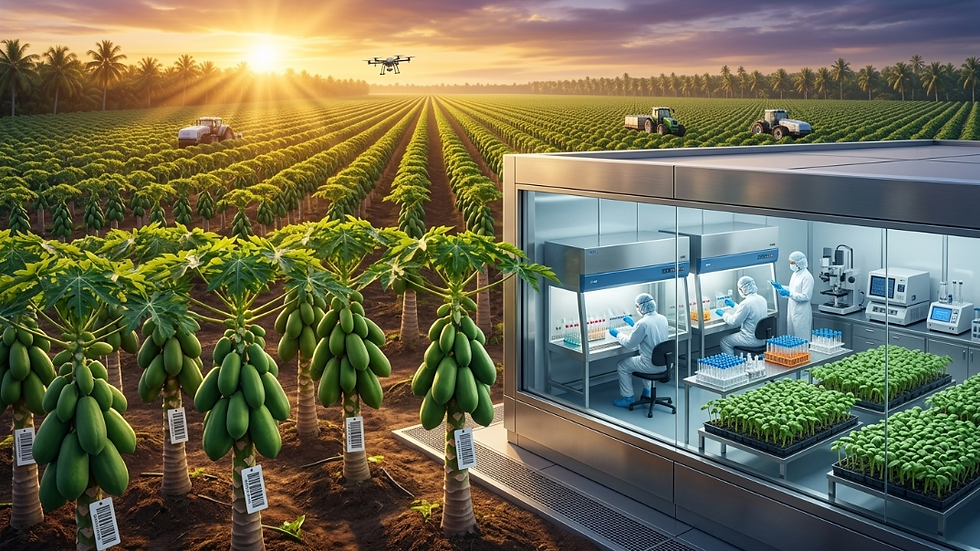
Papaya plants are generally divided into three main sexes: male, female, and hermaphrodite. Each type has distinct characteristics and economic value. Male plants primarily produce pollen and rarely generate commercially valuable fruit. Female plants can produce fruit, but the fruits are often round or short-oval in shape. Hermaphrodite papayas, on the other hand, are the most preferred type in the fresh fruit market because they typically produce elongated or pear-shaped fruits with uniform appearance and the ability to self-pollinate.
From a commercial perspective, one of the major advantages of hermaphrodite papayas is the consistency of fruit production. For example, export-oriented papaya farms often require elongated fruits with uniform size and shape that are easy to pack into cartons for international markets. These characteristics are commonly associated with hermaphrodite plants, making their fruits more valuable than those from female plants, which may sometimes fail to meet market standards in terms of shape and uniformity.
Another major issue with seed-grown papaya cultivation is that plant sex cannot be identified during the seedling stage. Farmers often plant three to five seedlings per hole and wait until flowering before removing unwanted plants. This practice increases costs related to seeds, fertilizers, land usage, and labor. In large-scale plantations, these losses become even more significant.
This is one of the main reasons why commercial seedling businesses are increasingly turning to hermaphrodite papaya tissue culture. By propagating plants from carefully selected mother plants with confirmed sexual characteristics, producers can generate cloned plants with traits highly similar to the original mother plant, including fruit shape, flesh color, sweetness, and overall commercial quality. For example, if a mother plant produces long fruits with sweet red flesh and high yield potential, tissue-cultured clones are more likely to maintain these desirable traits consistently.
However, the term “better” does not necessarily mean that hermaphrodite papayas are ideal under all conditions. In some regions with cooler climates or unstable environmental conditions, hermaphrodite plants may experience floral abnormalities or changes in sex expression. In certain cases, they may develop malformed flowers, produce male-like characteristics, or generate incomplete flowers, ultimately affecting fruit set and overall productivity.
From a tissue culture perspective, hermaphrodite plants are not always easier to propagate either. Some research studies suggest that certain male papaya lines may actually produce shoots more rapidly in culture media than hermaphrodite plants. Therefore, the main advantage of hermaphrodite papayas lies more in their post-planting commercial value and market suitability rather than laboratory propagation efficiency.
Today, molecular marker technology and genetic sex identification systems are increasingly being used to determine papaya sex at the seedling stage. These technologies help commercial nurseries identify hermaphrodite plants more accurately, reducing the risk of producing unwanted plant types and improving efficiency in commercial seedling production planning.
Another important factor is the selection of mother plants. Producing high-quality hermaphrodite papaya seedlings requires more than simply choosing a hermaphrodite plant. Producers must also evaluate fruit quality, flower stability, disease resistance, and field performance under real growing conditions. Even among hermaphrodite plants, significant differences may exist in fruit quality and productivity.

For commercial seedling businesses, hermaphrodite papaya tissue culture represents a highly promising opportunity because it meets the needs of modern farmers who want sex-confirmed planting materials, reduced thinning costs, and more predictable production systems. For example, industrial-scale papaya farms can immediately plant one seedling per hole without waiting for flowering and sex selection, significantly reducing labor costs and improving plantation management efficiency.
Ultimately, from the perspective of the fresh fruit market and commercial seedling production, hermaphrodite papayas offer several advantages over male and female plants, particularly in terms of fruit quality, uniformity, and commercial value. However, the success of tissue-cultured papaya production still depends heavily on the quality of the mother plant, propagation technology, and field performance evaluation. No matter how advanced the technology may be, poor mother plant selection can still prevent the production of truly high-quality commercial planting materials.
✨ channel for ordering ✨
Facebook Fanpage : ไทยทิชชู – ต้นไม้เพาะเนื้อเยื่อ ( Inbox 📩)
TikTok Shop : https://www.tiktok.com/@thaitissueshop
Shopee : https://shopee.co.th/thaitissue
🌱Other Contacts🌱
☎️ : 06-4475-7495 , 08-8629-4513
Line OA : https://lin.ee/UQFnpoN
Website : https://www.thaitissues.com/


good