

Aquatic Plant Tissue Culture: Producing Clean Planting Material for the Aquascaping Industry

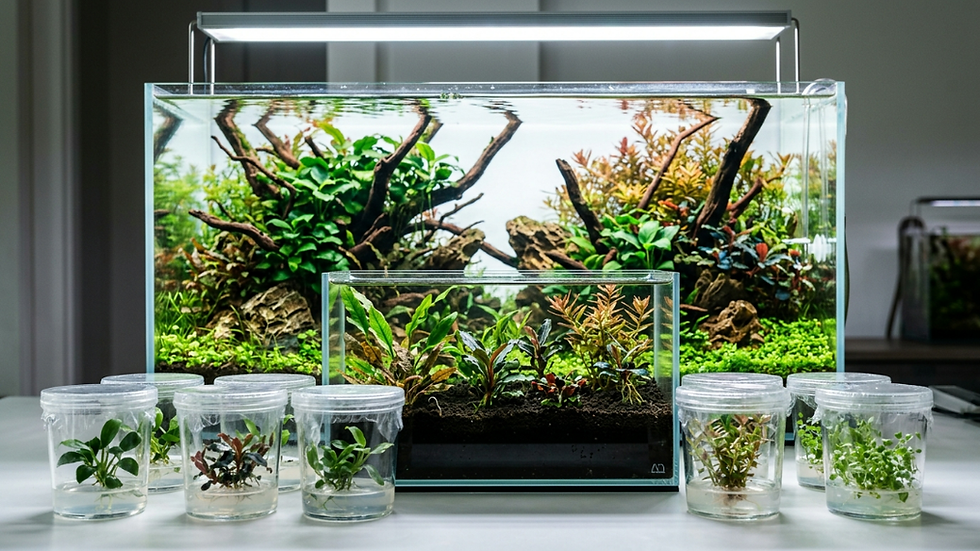
Aquatic plant tissue culture is playing an increasingly important role in the aquarium and aquascaping industries. It enables large numbers of plants to be produced rapidly, requires relatively little production space, and supports year-round propagation.
One of its greatest advantages is the reduced risk of introducing snails, snail eggs, algae, nematodes, insects, and contaminants associated with soil or conventional growing media into an aquarium. However, the term “tissue-cultured plant” does not automatically mean that the plant is free from every virus or internal pathogen. If freedom from specific pathogens is required, the production system must include tested mother stock and additional quality-control procedures.
Why Aquatic Plants Can Be Difficult to Establish In Vitro
Aquatic plants are often more difficult to establish in tissue culture than many terrestrial species because they remain in constant contact with water, sediment, organic matter, and biofilms.
Their rhizomes, nodes, roots, and leaf axils may carry bacteria, fungi, algae, cyanobacteria, and nematodes. Some microorganisms can also live inside the plant tissue and cannot be eliminated through surface sterilization alone.
Increasing the concentration of disinfectants without preliminary testing may reduce visible contamination, but it can also damage delicate tissues. Young leaves and shoot tips may bleach, rot, or lose their ability to regenerate.
The objective of sterilization is therefore not simply to produce the cleanest-looking vessel. It is to obtain the highest number of explants that remain clean, alive, and capable of producing healthy shoots.
Mother Plant Preparation Is Essential
Proper mother plant preparation is one of the most important stages in aquatic plant tissue culture.
Plants collected from aquariums, earthen ponds, or natural waterways should ideally be transferred into a clean greenhouse and grown under emersed conditions before explants are collected. Emersed mother plants generally carry a lower microbial load than plants kept continuously underwater and may produce stronger new shoots.
For example, Hygrophila and other stem-type aquatic plants can be grown above the waterline until they produce fresh shoots. Young nodes or shoot tips can then be collected for laboratory establishment rather than sterilizing plants covered with sediment, algae, and aquatic biofilm directly from the aquarium or pond.
This preparation stage can substantially improve explant quality and reduce the need for excessively harsh disinfection.
Selecting Explants According to Plant Growth Habit
The most suitable explant depends on the plant’s growth form.
Slow-growing rhizomatous plants such as Anubias, Bucephalandra, and Cryptocoryne are commonly initiated from shoot buds or rhizome buds. Stem plants such as Hygrophila, Rotala, Staurogyne, and Micranthemum are generally more suitable for propagation from nodal segments or young stems.
For Aponogeton and certain lotus or water-lily-type plants, young storage organs or meristematic tissue located inside the tuber may be used.
When the goal is to produce plants that remain as close as possible to the mother plant, direct shoot development from existing buds or nodes should generally be prioritized over callus-based regeneration. Prolonged callus phases may increase the risk of changes in leaf color, leaf shape, growth habit, or overall plant form.
This is particularly important for variegated cultivars and slow-growing collector plants, where even small changes can affect commercial value.
Basal Media and Culture Conditions
Full-strength MS and half-strength MS media are commonly used as starting formulations for aquatic plant tissue culture. A typical medium may contain approximately 30 g/L sucrose, with the pH adjusted to around 5.7–5.8.
Cultures are often maintained at temperatures of approximately 22–25°C under controlled lighting.
BA or BAP is widely used to stimulate shoot proliferation. TDZ may also produce high shoot numbers, but it carries a greater risk of generating short, tightly clustered, or hyperhydric shoots.
Research involving Anubias barteri var. nana, for example, found that medium supplemented with 3 mg/L BA produced approximately five green shoots per explant under the conditions tested. Certain Bucephalandra clones have also responded well to BA concentrations of around 5 mg/L.
These values should be regarded as experimental starting points rather than universal formulas. Different species, cultivars, and clones may respond very differently to the same mineral and hormone concentrations.
The Highest Shoot Number Is Not Always the Best Result
A culture medium that produces the greatest number of shoots is not necessarily the best option for commercial production.
Large shoot numbers may include plantlets that are:
Too small to separate
Difficult to handle
Hyperhydric
Weakly rooted
Abnormally shaped
Slow to recover after transfer
Unsuitable for aquarium establishment
Commercial evaluation should therefore consider the number of usable shoots rather than total shoot number alone.
Important measurements include:
Shoot length
Leaf color
Leaf shape
Shoot strength
Hyperhydricity
Ease of separation
Rooting ability
Survival after transfer
Growth after planting in aquatic conditions
For example, Bucephalandra ‘Red Mini’ has been reported to produce more than 20 shoots per culture on media containing TDZ and high sucrose concentrations. However, before such a formula is adopted for mass production, the resulting shoots must be assessed for normal morphology, rooting, acclimatization survival, and subsequent aquarium performance.
A lower-multiplication treatment may be more profitable if it produces a higher proportion of healthy, marketable plants.
Rooting May Require Little or No Auxin
Many aquatic plants do not require high auxin concentrations during rooting. Some species form functional roots effectively on half-strength or quarter-strength MS medium without plant growth regulators.
Research involving Echinodorus ‘Indian Red’, for example, found that IBA-containing medium produced a greater number of roots, while roots formed on hormone-free medium were longer and more suitable for transfer from culture vessels.
This demonstrates why rooting protocols should not be selected from root number alone.
The evaluation should also include:
Root length
Root branching
Root thickness
Basal callus formation
Plantlet stability
Survival after planting
Ability to anchor in aquarium substrate
Strong, functional roots that adapt quickly to aquasoil or another substrate may be more valuable than a large number of short or hormone-induced roots.
Acclimatization Above or Below Water
Aquatic tissue-cultured plants can be acclimatized under emersed conditions or transferred directly underwater, depending on the species.
Slow-growing rhizomatous plants such as Anubias, Bucephalandra, and Cryptocoryne often benefit from an initial period in a high-humidity greenhouse before being transferred into an aquarium.
Carpeting plants and well-rooted Echinodorus plantlets may sometimes be transferred directly into aquasoil or submerged systems, provided that the plants are strong and environmental conditions are controlled.
Studies involving Micranthemum ‘Monte Carlo’ and Cryptocoryne ‘Flamingo’ have reported 100% survival in several growing substrates under the conditions tested. However, plants grown in aquasoil generally showed better growth than those planted in sand alone.
Before transfer, agar should be washed carefully from the roots and basal tissues. Residual sugar and nutrients can encourage microbial growth and algae development outside the culture vessel.
The plants should then be observed for new leaf and root formation under the intended production or aquarium conditions.

Variegated Aquatic Plants Need Additional Quality Control
Variegated aquatic plants require particularly careful protocol design because their color patterns may be unstable.
For Anubias ‘Pinto’, rhizome buds should generally be used, while prolonged callus culture should be minimized to reduce the risk of losing or changing the variegation pattern.
For Bucephalandra ‘Mini Rau’, a practical approach would be to compare several BA concentrations before attempting to scale production using a temporary immersion system.
Variegated Hygrophila should be managed differently. Since stem-type plants may already multiply relatively easily, the priority may be controlling latent contamination and maintaining leaf color rather than maximizing shoot number.
Each mother plant or clone should be kept under a separate culture-line code, especially during pilot production. This makes it possible to identify which source maintains stable coloration and which source produces green reversions, weak shoots, or abnormal growth.
Clean in Vitro Plants Are Not Automatically Pathogen-Free
The absence of visible fungi, bacteria, algae, or cloudiness inside the vessel confirms only that the culture appears microbiologically clean under the production conditions used.
It does not prove that the plant is free from every virus, viroid, endophyte, or systemic pathogen.
If a producer wishes to use terms such as virus-tested, pathogen-tested, or disease-free, the target organisms and test methods should be specified. Testing may involve PCR, RT-PCR, ELISA, microbial culture, or other validated diagnostic systems, depending on the plant and pathogen concerned.
A scientifically accurate statement would be:
Produced under sterile in vitro conditions and visually free from snails, algae, and growing-medium contaminants.
A stronger disease-free claim requires additional evidence.
Commercial Production Requires Crop-Specific Protocols
Aquatic plants should not all be produced using the same tissue culture formula.
A commercial laboratory should develop separate protocol groups according to growth habit and biological response, such as:
Rhizomatous aquatic plants
Stem plants
Carpeting plants
Rosette-forming species
Tuberous plants
Variegated cultivars
Slow-growing collector plants
Protocol development should evaluate the entire production chain:
Mother plant preparation
Explant selection
Surface sterilization
Delayed contamination
Shoot multiplication
Shoot quality
Root formation
Acclimatization
Survival after submersion
Growth in aquarium substrate
Final commercial grading
The success of the system should be measured by the number of healthy plants that survive and grow after being placed in real aquarium conditions—not simply by the number of shoots observed inside the culture vessel.
Producing Cleaner Plants for the Aquascaping Market
Aquatic plant tissue culture has strong potential for producing clean, uniform planting material for aquarium and aquascaping markets.
Its principal advantage is the ability to reduce the introduction of snails, snail eggs, algae, nematodes, insects, sediment, and conventional growing-medium contaminants. However, successful production requires more than sterile laboratory handling.
It depends on clean mother stock, species-appropriate explants, careful sterilization, suitable mineral and hormone formulations, functional rooting, and an acclimatization system designed for the plant’s actual growth habit.
The best commercial protocol is not the formula that produces the highest number of shoots. It is the system that consistently produces healthy, true-to-type plants with strong roots, high post-transfer survival, and reliable performance after they are placed in aquasoil or submerged in an aquarium.
✨ channel for ordering ✨
Facebook Fanpage : ไทยทิชชู – ต้นไม้เพาะเนื้อเยื่อ ( Inbox 📩)
TikTok Shop : https://www.tiktok.com/@thaitissueshop
Shopee : https://shopee.co.th/thaitissue
🌱Other Contacts🌱
☎️ : 06-4475-7495 , 08-8629-4513
Line OA : https://lin.ee/UQFnpoN
Website : https://www.thaitissues.com/


Comments