

How to Start an OEM Tissue Culture Project from a Quality Mother Plant
- TTCI Blog
- 16 hours ago
- 2 min read

A good mother plant needs a clear production plan
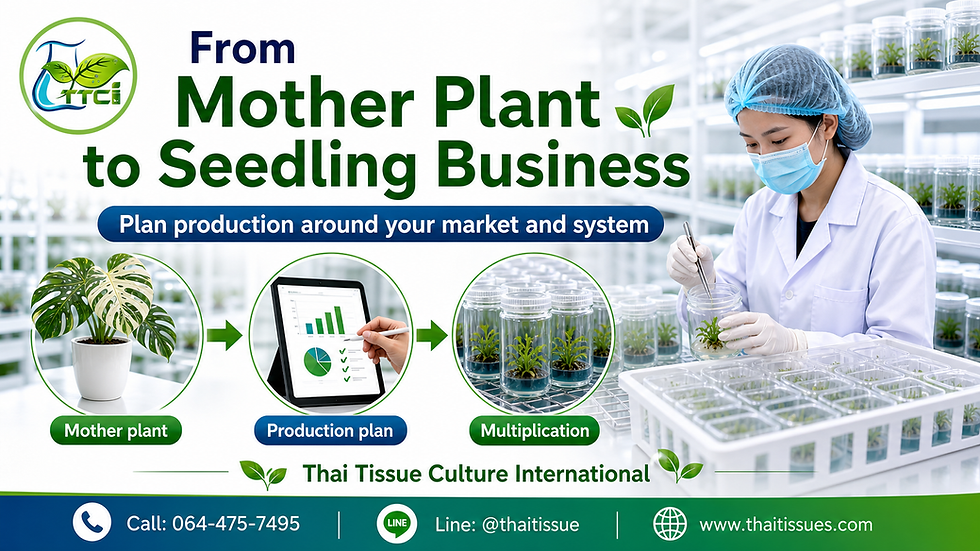
Many OEM tissue culture projects begin with one practical asset: a selected mother plant. It may be a promising commercial variety, a plant with distinctive traits, or a stock plant that the customer wants to multiply for a larger market plan. From the laboratory perspective, the project does not begin by placing the plant into culture immediately. It begins by understanding the plant, the desired production volume, and the preferred delivery format.
TNAU Agritech Portal describes micropropagation as the production of many plants from selected plant tissues under controlled conditions. This makes tissue culture highly relevant when a customer already has a clear source plant and wants a more systematic multiplication route. However, good results depend on the quality of the starting information as much as the laboratory technique itself.
Before an OEM assessment, customers should prepare the plant name or variety, current photos of the mother plant, the number of available mother plants, the target quantity, and the preferred delivery format: in-vitro plantlets, acclimatized young plants, or ready-to-plant material. These details help the laboratory evaluate the likely starting material, the production direction, and the practical next step.
The USDA/ARS Micropropagation system document frames micropropagation as a system involving stock plants, culture handling, media, vessels and growth-room conditions. This system view is useful for OEM customers because it shows that production planning is not only about asking whether a plant can be cultured. It is also about matching the plant, quantity, timeline and delivery format.
For TTCI, early assessment helps make the conversation more precise. Instead of giving a general answer, the team can look at the actual mother plant, the customer’s target, and the intended use of the finished plantlets. When the starting point is clear, the production plan, communication, and expectation setting become stronger.
Information to prepare
- Plant name or variety
- Current photos of the mother plant
- Number of available mother plants
- Target production quantity
- Preferred delivery format: in-vitro, acclimatized, or ready-to-plant
If you have a mother plant or selected variety that you want to multiply, contact Thai Tissue Culture International to share photos and basic project details for an initial OEM assessment.
References
- TNAU Agritech Portal. Tissue Culture - An Introduction. https://agritech.tnau.ac.in/bio-tech/biotech_tc_notes.html
- USDA Agricultural Research Service. (1999). Micropropagation system. In Vitro Cellular & Developmental Biology - Plant, 35, 275-284. https://www.ars.usda.gov/ARSUserFiles/4630/InVitro/10.%20In%20Vitro%20-%20Plant%2035%20275-284%20%281999%29%20Microprop%20system.pdf
- National Certification System for Tissue Culture Raised Plants (NCS-TCP), Department of Biotechnology, Government of India. Guidelines, 4th Revision. https://dbtncstcp.nic.in/doc/NCS-TCP-Guidelines-4th-Revision-on-April-16-2019.pdf


Comments