

OEM Tissue Culture Is Production Planning, Not Just Plant Culturing
- TTCI Blog
- 16 hours ago
- 2 min read

OEM tissue culture is a production system
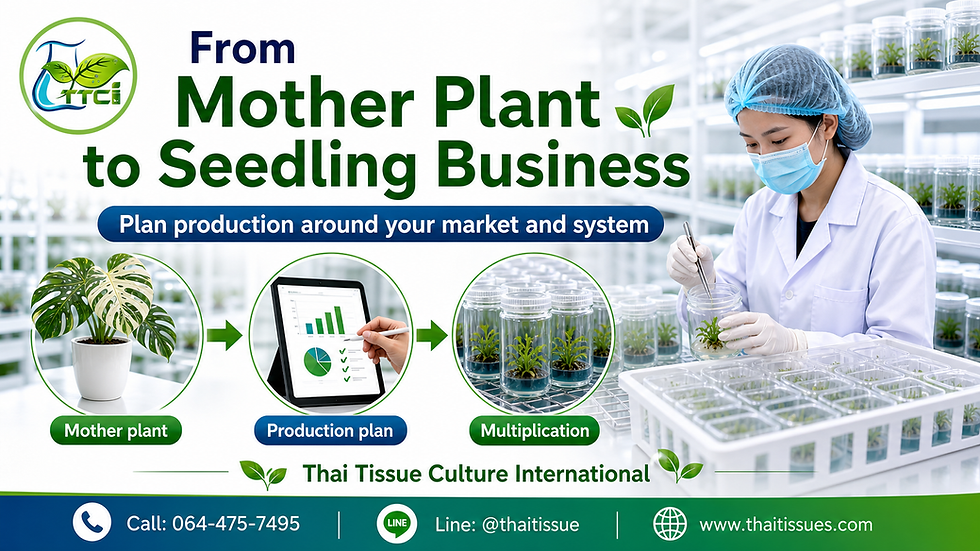
When customers hear “OEM production,” they may imagine sending a plant to the laboratory and waiting for a large number of plantlets. In practice, OEM tissue culture is a planned production workflow. It includes plant information intake, mother-stock or explant assessment, laboratory initiation, multiplication, rooting or acclimatization, quality review and delivery.
The USDA/ARS Micropropagation system document makes an important point: micropropagation is a system, not a single isolated step. Stock plants, culture handling, media, containers and growth-room conditions all contribute to the final result. This is directly relevant to OEM work because production planning must connect multiple stages rather than focus only on the multiplication number.
The general OEM workflow can be explained in six stages: receiving plant information and production goals, assessing mother stock or plant material, planning laboratory initiation, multiplying according to the target, rooting or acclimatizing according to the agreed delivery format, and reviewing quality before delivery. Each stage has decisions, observations and biological limits.
NCS-TCP SOPs for Accredited Test Laboratory highlight the value of documented procedures and verification in tissue culture systems. Although the document is written for a testing-laboratory context, the principle applies to OEM communication: a reliable system needs procedures, records and checkpoints rather than memory-based or ad hoc decisions.
For customers, understanding OEM as production planning improves the conversation with the laboratory. Target quantity should connect with timeline. Delivery format should connect with nursery readiness. Quality expectations should be discussed before work begins. Good planning reduces uncertainty for both sides.
Six stages of OEM tissue culture
1. Receive plant information and production goals 2. Assess mother stock or plant material 3. Plan laboratory initiation 4. Multiply according to target 5. Root, acclimatize, or nursery-grow according to delivery format 6. Review quality and deliver
For systematic OEM tissue culture production, contact Thai Tissue Culture International to review the plant, production goals and workflow from the beginning.
References
- USDA Agricultural Research Service. (1999). Micropropagation system. In Vitro Cellular & Developmental Biology - Plant, 35, 275-284. https://www.ars.usda.gov/ARSUserFiles/4630/InVitro/10.%20In%20Vitro%20-%20Plant%2035%20275-284%20%281999%29%20Microprop%20system.pdf
- National Certification System for Tissue Culture Raised Plants (NCS-TCP), Department of Biotechnology, Government of India. SOPs for Accredited Test Laboratory. https://dbtncstcp.nic.in/SOPs/SOPs-ATL.pdf
- TNAU Agritech Portal. Tissue Culture - An Introduction. https://agritech.tnau.ac.in/bio-tech/biotech_tc_notes.html


Comments