

Pineapple Tissue Culture: High-Quality Plant Production Technology for Modern Agricultural Industry
- นภสร ตาปะสี
- 3 hours ago
- 3 min read

Pineapple is one of the world’s most important economic crops, especially in Thailand, where it plays a major role in fresh consumption, food processing, juice production, and the extraction of high-value bioactive compounds such as bromelain for the nutraceutical and cosmeceutical industries. However, conventional pineapple propagation faces several limitations, including slow multiplication rates, inconsistent planting material quality, and the accumulation of diseases in suckers and crowns. As a result, pineapple tissue culture has become an increasingly important technology for modern agricultural industries.
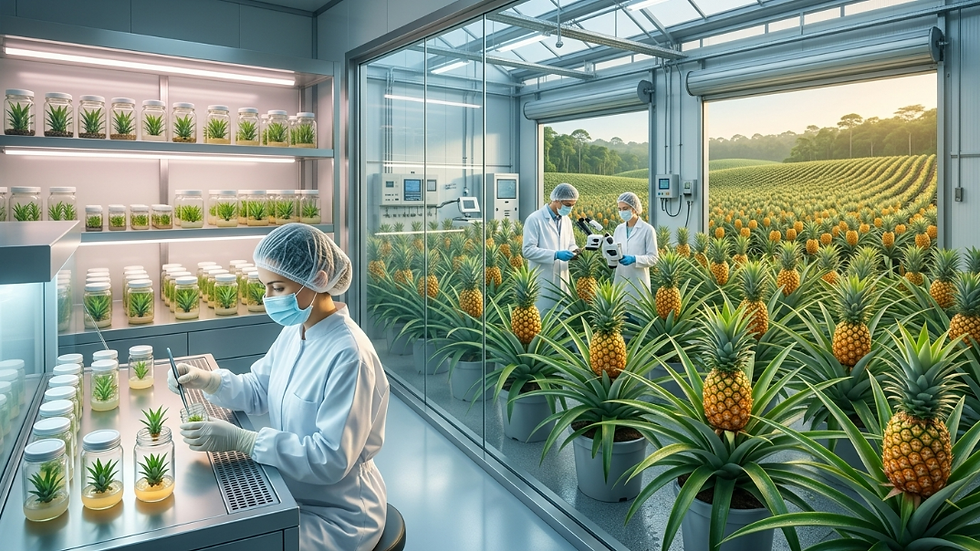
Pineapple tissue culture involves taking small parts of the plant — such as shoot tips, axillary buds, or crown tissues — and culturing them under sterile laboratory conditions using synthetic media and plant growth regulators to stimulate rapid plant regeneration. This technique enables the large-scale production of disease-free, uniform, and vigorous planting materials much faster than traditional propagation methods using suckers or crowns.
One of the reasons pineapple is highly suitable for tissue culture is the limitation of its natural propagation system. Pineapple plants produce relatively few suckers per production cycle, and traditional planting materials are highly susceptible to fungal, bacterial, and viral infections. For example, industrial pineapple plantations that repeatedly use the same propagation stock over multiple generations may experience declining yields and inconsistent fruit size, directly affecting processing factories and export markets.
The tissue culture process begins with selecting healthy, high-yield mother plants. Plant tissues are then sterilized using alcohol and sodium hypochlorite to minimize contamination before being transferred onto MS (Murashige and Skoog) medium supplemented with plant growth regulators such as BAP and NAA to induce multiple shoot formation. Once the shoots develop properly, they undergo multiplication and rooting stages using hormones like IBA or NAA before the young plantlets are acclimatized in greenhouse conditions.
Among the pineapple varieties commonly propagated through tissue culture, MD2 is the most commercially important due to its sweet flavor, golden-yellow flesh, and highly uniform fruit quality. For example, pineapple canning factories and juice-processing industries often require MD2 planting materials with synchronized growth and harvest periods to improve production planning and maintain consistent product quality.
Beyond fresh fruit production, pineapple is also a major source of bromelain, a natural enzyme widely used in the nutraceutical and cosmeceutical industries. Bromelain is known for its protein-digesting and anti-inflammatory properties and is commonly used in dietary supplements, post-workout recovery products, anti-swelling formulations, and even enzyme-based skincare products designed for gentle exfoliation.

Today, many laboratories are integrating Temporary Immersion Bioreactor (TIB) systems into pineapple tissue culture production to improve growth rates and reduce labor costs. This system periodically immerses plant tissues in liquid nutrient media, allowing better nutrient uptake and oxygen exchange. As a result, plantlets grow faster, become more vigorous, and can be produced on a massive scale within a relatively short period, making the technology highly suitable for industrial-scale propagation.
Despite its many advantages, pineapple tissue culture still faces several challenges, including contamination by fungi and bacteria, somaclonal variation, and plant losses during the acclimatization stage after removal from culture vessels. Therefore, laboratories must maintain strict quality control systems and employ skilled personnel specialized in tissue culture techniques to ensure successful commercial production.
In the future, pineapple tissue culture will likely evolve far beyond a simple plant propagation technique. It is becoming a key technology for modern agriculture, health food industries, and bioactive extraction sectors worldwide. By improving planting material quality, enhancing production efficiency, and supporting the rapidly growing functional food and wellness markets, tissue culture is helping transform pineapple into a high-value crop for the global bioeconomy.
✨ channel for ordering ✨
Facebook Fanpage : ไทยทิชชู – ต้นไม้เพาะเนื้อเยื่อ ( Inbox 📩)
TikTok Shop : https://www.tiktok.com/@thaitissueshop
Shopee : https://shopee.co.th/thaitissue
🌱Other Contacts🌱
☎️ : 06-4475-7495 , 08-8629-4513
Line OA : https://lin.ee/UQFnpoN
Website : https://www.thaitissues.com/


Comments