

Why Tissue Culture Plant Production Takes Time
- TTCI Blog
- 2 hours ago
- 3 min read

Many customers ask the same question: why does tissue culture production take several months, and can the lab make it faster? The practical answer is that tissue culture is not just a production schedule. It is a biological process.
In micropropagation, the lab does not place a plant part into a jar and immediately receive thousands of finished plantlets. The process normally moves through several stages: donor plant preparation, sterile establishment, shoot multiplication, rooting, and acclimatization. Each stage has a different purpose, and each stage affects the quality of the next one.
1. Production must start with clean cultures
The first challenge is not multiplication. It is getting the plant material to survive in an aseptic system. Explants can carry fungi, bacteria, or other contaminants from the mother plant, growing environment, water, soil, or handling process.
If sterilization is too light, contamination can overgrow the culture. If it is too strong, the plant tissue itself may be damaged. This is why establishment takes careful adjustment. A clean start protects the rest of the production cycle.
2. Multiplication happens in cycles, not instantly
Customers may imagine that one plant part can become one thousand plantlets in a single step. In reality, multiplication happens through repeated subculture cycles. Shoots must grow enough to be separated, transferred to fresh medium, and multiplied again.
A simple way to explain the logic is 1 to 4 to 16 to 64 to 256 and onward. Each cycle takes time because the plant needs to grow before it can be divided again. IITA technical material for banana micropropagation shows that multiplication is influenced by genotype, hormone concentration, and subculture level, and that production planning happens over repeated cycles rather than overnight.
3. Every plant type responds differently
Plants are not identical production units. Some species multiply quickly. Some are slower. Some root easily. Some need formula adjustment. Some are more sensitive to browning, contamination, or acclimatization stress.
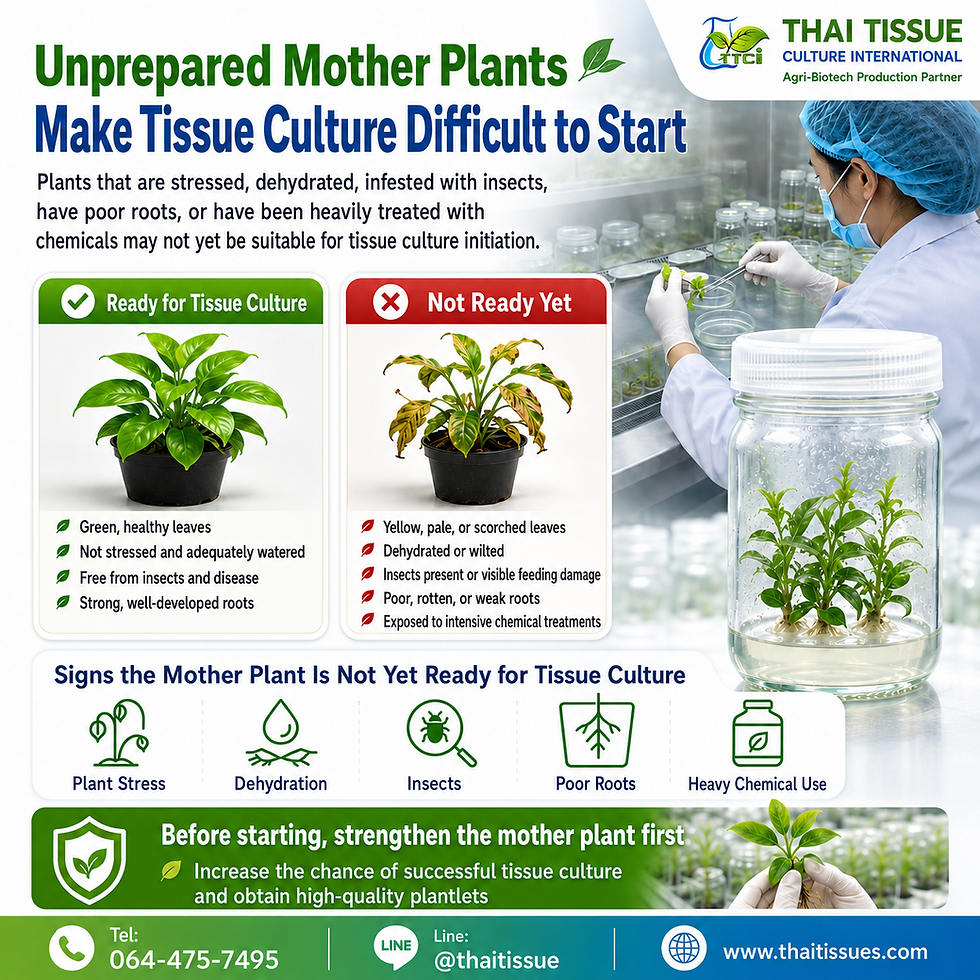
Plant tissue culture literature notes that success depends on many factors, including genotype, donor plant condition, explant type, surface disinfection, culture medium, plant growth regulators, light, photoperiod, and temperature. This is why a professional lab evaluates the plant and adjusts the protocol instead of assuming one formula works for every crop.
4. A plantlet in a jar is not always ready outside the jar
In vitro plantlets grow in a highly controlled environment. Humidity is high, light is controlled, and roots develop inside culture conditions. Once plantlets leave the jar, they must adapt to lower humidity, stronger light, water loss, substrate conditions, and functioning roots.
This final acclimatization stage is critical. If plantlets are moved or delivered too early, they may look ready but still struggle after transfer. Speed without readiness can create more risk than value.
5. Time is part of quality control
From the customer’s side, the timeline may look like waiting. From the lab’s side, the same time is used to monitor cleanliness, multiplication response, rooting, plantlet strength, and readiness for acclimatization or delivery.
Rushing beyond the biological pace of the plant can increase the risk of contamination, weak roots, poor acclimatization, and lower nursery performance. A reliable tissue culture program should therefore be planned early, especially when the target quantity is large or the species is new to the lab.
Good tissue culture plantlets are not created by speed alone. They come from the right process: sterile establishment, controlled multiplication, rooting, and careful acclimatization.
If you are planning OEM tissue culture production, contract propagation, or commercial-scale plant multiplication, contact Thai Tissue Culture International for an initial assessment of species, target quantity, and production timeline.
✨ channel for ordering ✨
Facebook Fanpage : ไทยทิชชู – ต้นไม้เพาะเนื้อเยื่อ ( Inbox 📩)
TikTok Shop : https://www.tiktok.com/@thaitissueshop
Shopee : https://shopee.co.th/thaitissue
🌱Other Contacts🌱
☎️ : 06-4475-7495 , 08-8629-4513
Line OA : https://lin.ee/UQFnpoN
Website : https://www.thaitissues.com/


Comments