

Makapuno Coconut Tissue Culture: Rescuing Embryos That Cannot Germinate Naturally
- นภสร ตาปะสี
- 2 days ago
- 5 min read

Makapuno coconut is distinguished by its unusually thick, soft, fluffy, or jelly-like flesh, which differs markedly from the firm, oil-rich meat of a normal mature coconut. Internationally, it is commonly known as Makapuno or Kopyor. This unique characteristic results from an abnormality in the endosperm—the tissue that normally stores nutrients and supports embryo germination in a regular coconut fruit. Because the endosperm in Makapuno coconut has an altered structure and composition, the living embryo inside the fruit cannot develop and germinate normally on its own.

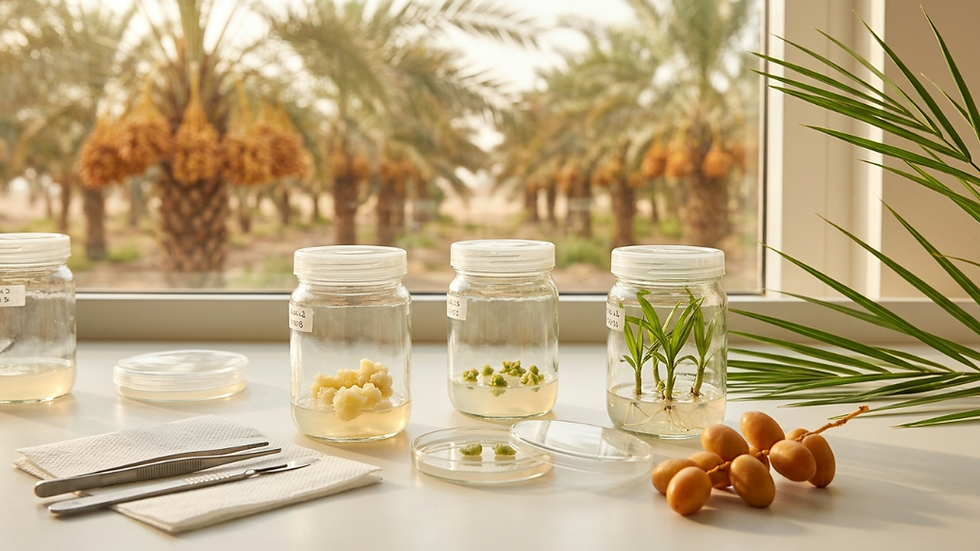
The technique used to overcome this problem is known as zygotic embryo culture, or embryo rescue. The process begins by opening the fruit through the soft eye of the shell and removing a section of endosperm containing the embryo. This tissue is surface sterilized, after which the small embryo is carefully isolated and placed on a synthetic culture medium.
The medium contains sugar, mineral nutrients, vitamins, plant growth regulators, and other components under controlled environmental conditions. It effectively replaces the function of the abnormal endosperm. For example, an embryo taken from a Makapuno fruit that would not germinate naturally may begin developing a shoot and haustorium-like absorbing structure when cultured on a suitable Y3 medium, before later producing leaves and roots.
An important point to understand is that embryo culture is not a one-to-one cloning method. A zygotic embryo is formed through fertilization between male and female gametes, meaning that each regenerated plant may have a different genetic combination, even when all embryos come from Makapuno fruits.
For example, 1,000 Makapuno fruits generally provide approximately one initial embryo per fruit. They do not multiply into tens of thousands of plantlets in the same way that banana shoots can be repeatedly multiplied in vitro. The final number of viable plants will also be reduced by contamination, failure to germinate, incomplete root development, and losses during nursery acclimatization.
Why Y3 Medium Is Commonly Used for Coconut
The most widely used basal medium for coconut tissue culture is Eeuwens Y3 medium, which was developed for palms and is often more suitable for coconut than standard MS medium. Depending on the protocol, Y3 medium may contain approximately 3–6% sucrose together with NAA, BA or BAP, and activated charcoal.
Sucrose provides energy and helps regulate osmotic pressure, while activated charcoal may adsorb phenolic compounds and other substances associated with tissue browning. However, a formula reported in one study should not automatically be applied to every coconut type. Tall coconuts, dwarf coconuts, standard Makapuno, and aromatic Makapuno may respond differently to the same medium and hormone combination.
Sterilization Is One of the Most Critical Steps
Sterilization must be carefully controlled throughout the process. Although the embryo is protected inside the coconut shell, microorganisms from the fruit surface, tools, or internal cavities may enter the tissue while the fruit is being opened and the endosperm section is removed.
For this reason, sterilization is often carried out in two stages. The endosperm section containing the embryo is sterilized first. The embryo is then isolated and subjected to a second sterilization step before culture.
Some older studies used mercuric chloride, but this chemical is highly toxic and creates hazardous waste management concerns. Modern laboratories should therefore develop safer alternatives, such as sodium hypochlorite-based protocols, while carefully testing concentration and exposure time. The objective is to reduce contamination without damaging the delicate embryo.
Root Development Remains a Major Challenge
Even after an embryo germinates and produces a shoot, root development remains one of the main weaknesses in Makapuno coconut plantlet production. A plantlet with only one long primary root may appear healthy inside the vessel, but after transplanting it may absorb water poorly and adapt slowly.
Research has shown that trimming the primary root at an appropriate stage can encourage the formation of more lateral roots. This is important for improving survival after deflasking. A plantlet with several well-developed lateral roots and strong true leaves is generally better prepared for transfer into growing medium than a tall plantlet supported by only one primary root.
Acclimatization Is Part of the Technology
The nursery stage is another period in which substantial plant losses may occur. Plantlets grown in vitro are accustomed to high humidity, low light, and sterile conditions. Once removed from the vessel, they must begin regulating water loss, increasing photosynthetic activity, and adapting their roots to a real growing substrate.
A common approach is to keep newly deflasked plantlets under covers or in a high-humidity chamber during the initial stage. The covers are then gradually perforated or opened to increase ventilation before the plants are moved into a shaded greenhouse.
Research in the Philippines has shown that improvements in acclimatization systems can substantially increase post-deflasking survival. This demonstrates that the nursery is not simply a stage that follows laboratory work. It is an integral part of the embryo rescue technology itself.

Evidence from Makapuno Coconut Research in Thailand
Research conducted in Thailand has confirmed that embryos from aromatic Makapuno coconuts can be developed into complete seedlings and successfully transferred to field conditions.
In one project by Thailand’s Department of Agriculture, the process began with 960 embryos. Of these, 613 continued to develop, and 374 became complete seedlings—equivalent to approximately 38.96% of the original embryos—before the strongest plants were selected for field planting.
These figures demonstrate both the feasibility and the difficulty of the process. Embryo rescue can produce viable Makapuno coconut seedlings, but losses occur at every stage, including sterilization, germination, root development, and acclimatization.
Does Embryo Culture Guarantee “100% Makapuno”?
The phrase “100% Makapuno coconut” must be communicated carefully. The outcome does not depend on embryo culture alone. It is also influenced by the genetic background of the trees and the source of pollen in the plantation.
If embryo-derived trees are planted near ordinary coconut trees without controlled pollination, the proportion of Makapuno fruits in the next generation may change. A well-managed breeding or seed production orchard should therefore be isolated from standard coconut plantations where possible. Pollination should be controlled, pedigree records should be maintained, and genetic markers may be used to help preserve both the Makapuno trait and desirable aromatic characteristics.
A Practical Technology, but Not a Rapid Multiplication System
In summary, Makapuno coconut tissue culture is primarily a method of rescuing embryos that cannot germinate naturally. The main technique is zygotic embryo culture, and success depends on carefully controlling the fruit source, embryo maturity, sterilization, Y3 medium, browning, lateral root formation, and step-by-step acclimatization.
The technology has genuine commercial potential, but it is time-consuming, labor-intensive, and does not provide exponential multiplication in the same way as shoot-based micropropagation systems.
Clonal propagation through somatic embryogenesis has made progress in coconut research and may eventually offer greater multiplication potential. However, the technology still needs further development to produce complete, uniform plantlets consistently before it can be used as a reliable basis for large-scale commercial production planning.
✨ channel for ordering ✨
Facebook Fanpage : ไทยทิชชู – ต้นไม้เพาะเนื้อเยื่อ ( Inbox 📩)
TikTok Shop : https://www.tiktok.com/@thaitissueshop
Shopee : https://shopee.co.th/thaitissue
🌱Other Contacts🌱
☎️ : 06-4475-7495 , 08-8629-4513
Line OA : https://lin.ee/UQFnpoN
Website : https://www.thaitissues.com/

Comments